
Commercial Fire Alarm Systems
Cunningham Security Systems designs, installs, monitors, inspects and services commercial fire alarm systems for businesses, property managers, contractors and building owners throughout Maine, New Hampshire and Massachusetts.
Whether you are planning a new system, replacing an aging fire alarm panel, completing a tenant fit-out or correcting inspection deficiencies, Cunningham can help coordinate the project from the initial site review through design, permitting, installation, testing and final approval.
Our commercial fire alarm work includes addressable and conventional systems, CAD drawings, AHJ coordination, permit support, professional monitoring, recurring inspections and electronic documentation through BuildingReports.
Key Takeaways
- Commercial fire alarm projects begin with the building.
The occupancy, floor plan, existing equipment, notification requirements and local AHJ process all influence the correct design. - Addressable and conventional systems operate differently.
Addressable systems identify individual devices, while conventional systems generally identify the zone where an event occurred. - Permits and documentation matter.
Drawings, calculations, product information, programming documentation and inspection records may all be necessary to complete a project. - Installation is only part of the system lifecycle.
Commercial systems also require monitoring where applicable, inspections, testing, repairs, documentation and long-term service support.
Commercial Fire Alarm Systems Designed Around Your Building
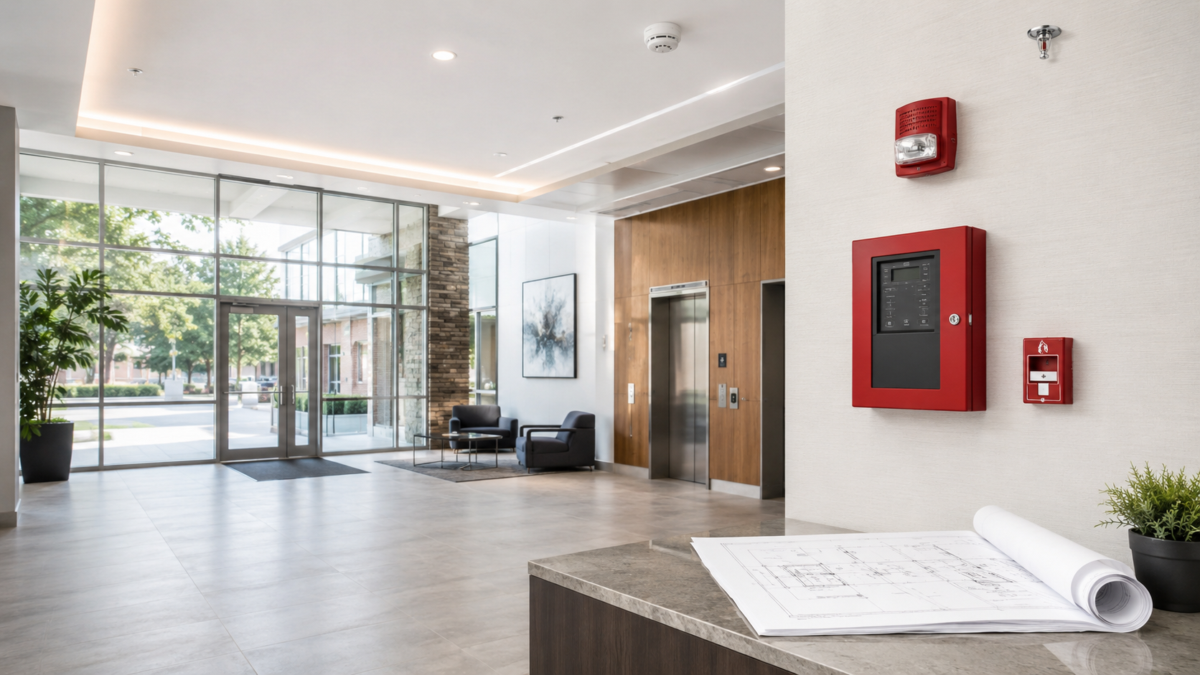
A commercial fire alarm system is a building-wide life-safety system. It must be designed around the occupancy, floor plan, number of occupants, required notification, applicable codes, local Authority Having Jurisdiction and the way the property is used.
Cunningham works with owners, property managers, general contractors, electrical contractors, tenants, architects, facility teams and local officials to keep fire alarm projects organized. We can support new construction, renovations, tenant fit-outs, change-of-use projects, system replacements, device additions and fire alarm upgrades.
A commercial fire alarm system may include:
- Fire alarm control panels and power supplies
- Addressable or conventional initiating circuits
- Smoke detectors, heat detectors, duct detectors and carbon monoxide detection where applicable
- Manual pull stations
- Horn/strobes, strobes, speakers and other notification appliances
- Remote or graphic annunciators
- Sprinkler waterflow and valve-tamper monitoring
- Elevator recall and HVAC shutdown interfaces
- Fire-door and access-control release functions
- Kitchen hood or suppression-system interfaces where applicable
- Fire alarm communicators and central-station monitoring
- Inspection, testing and system documentation
Addressable vs. Conventional Fire Alarm Systems
Both addressable and conventional systems can provide appropriate fire protection when correctly designed and permitted. The right choice depends on the size and complexity of the building, applicable requirements, existing wiring, future expansion plans and budget.
Addressable Fire Alarm Systems
An addressable system identifies individual devices. The panel can display the specific smoke detector, pull station, module or other device involved in an alarm, supervisory or trouble condition.
- Device-level identification
- Faster troubleshooting
- Flexible programming options
- Better support for larger buildings
- More practical future expansion
- Clearer event and service information
Conventional Fire Alarm Systems
A conventional system groups initiating devices into zones. When an event occurs, the panel identifies the affected zone rather than the exact individual device.
- Straightforward system architecture
- Practical for smaller properties
- Familiar technology
- Potentially lower initial equipment cost
- Useful when zone-level identification is sufficient
- Can be appropriate for limited-scope projects
Which system is better?
Neither type is automatically best for every property. Cunningham reviews the building, occupancy, device count, wiring, notification needs, monitoring requirements, future plans and AHJ expectations before recommending a system.
Commercial Fire Alarm Products: Potter, Fire-Lite and Autocall
Cunningham works with established commercial fire alarm product lines including Potter, Fire-Lite and Autocall. Equipment is selected according to the building and project—not simply by choosing a familiar brand name.
We consider system capacity, current wiring, required interfaces, product availability, serviceability, inspection history, programming needs and future expansion before recommending equipment.
Potter Fire Alarm Systems
Potter equipment can be a strong fit for new installations, upgrades and system replacements where modern capabilities, serviceability and expansion options are important.
Fire-Lite Fire Alarm Systems
Fire-Lite systems are widely used in commercial applications and can be a practical option for small and midsized buildings, offices, retail locations, tenant spaces and system replacements.
Autocall Fire Alarm Systems
Autocall products can support commercial life-safety applications where system capability, flexibility and long-term support are important. Cunningham can evaluate whether Autocall is appropriate for the building and project requirements.
CAD Fire Alarm Design, AHJ Review and Permit Coordination
A commercial fire alarm project often requires more than installing equipment. Depending on the building and jurisdiction, the submission package may include CAD drawings, device layouts, product data, riser diagrams, battery calculations, voltage-drop calculations and sequence-of-operation information.
Cunningham helps coordinate the process so owners, contractors and tenants are not left guessing about the fire department, building department or other AHJ requirements.
Our commercial fire alarm process may include:
- Site review and project discovery.
We review the occupancy, existing equipment, available drawings, inspection history and project goals. - Requirements and AHJ review.
We identify applicable project requirements and coordinate with the local AHJ when necessary. - CAD design and system layout.
Drawings can identify the control panel, initiating devices, notification appliances, modules, annunciators and system interfaces. - Submittal documentation.
The package may include product data, device legends, riser diagrams, calculations and sequence-of-operation information. - Permit coordination.
Cunningham pulls or coordinates the required fire alarm permits before installation begins. - Professional installation and programming.
The system is installed and programmed according to the approved design and project requirements. - Pretesting and final inspection support.
We test the system, address punch-list items and support the acceptance process. - Closeout documentation.
The owner, contractor or AHJ receives applicable testing, inspection and system records.
Fire Alarm Support for Certificate of Occupancy Requirements
The fire alarm system can be a critical part of obtaining a certificate of occupancy. Delays can occur when drawings have not been approved, permits are incomplete, devices do not operate as required or documentation is unavailable.
Cunningham helps organize the fire alarm portion of the project by coordinating design, AHJ review, permits, installation, testing, acceptance inspection and closeout documentation.
The local AHJ makes the final decision concerning approval and issuance of a certificate of occupancy. Cunningham’s role is to help make sure the fire alarm system is properly designed, permitted, installed, tested, documented and ready for the required inspection.
Commercial Fire Alarm Inspections and BuildingReports Documentation
Fire alarm inspections help verify that initiating devices, notification appliances, supervisory functions, communications and other system components operate as expected. Inspection requirements depend on the system, building, adopted codes and local AHJ.
NFPA 72, National Fire Alarm and Signaling Code, provides a widely recognized framework for fire alarm and signaling system installation, inspection, testing and maintenance. Locally adopted requirements and AHJ direction ultimately govern each property.
Cunningham uses BuildingReports for electronic inspection documentation. This gives authorized property owners and managers convenient access to inspection reports, device information, deficiencies and historical records.
- Access reports electronically
- Review identified deficiencies
- Track inspections across multiple properties
- Share documentation with owners, insurers, contractors or officials
- Maintain more organized long-term records
Learn more about our commercial fire alarm inspections and testing or our dedicated Maine fire alarm inspection services.
Fire Alarm Monitoring, Service, Repairs and System Takeovers
Commercial Fire Alarm Monitoring
A fire alarm system may sound locally inside the building, but many properties also require or benefit from professional central-station monitoring. Depending on the system configuration, monitoring may include alarm, supervisory, trouble and communication signals.
Cunningham can install or upgrade compatible fire alarm communication equipment and configure response procedures around the property and applicable requirements.
Fire Alarm Service and Repairs
Older panels, failed batteries, damaged devices, wiring problems, ground faults, communication failures and inspection deficiencies can all create serious operational problems.
- Panel trouble conditions
- Smoke, heat, duct-detector and pull-station problems
- Horn, strobe and speaker failures
- Battery and power-supply issues
- Ground faults and wiring problems
- Sprinkler waterflow or tamper-monitoring issues
- Failed inspection items and deficiency corrections
- Communicator or monitoring problems
- Tenant-improvement device additions
- Panel replacements and system modernization
Existing-System Evaluations and Takeovers
Cunningham can evaluate an existing commercial fire alarm system to determine whether it should be serviced, expanded, taken over, partially upgraded or replaced. The evaluation may include the panel, field devices, wiring, communication path, documentation, inspection history and availability of replacement parts.
Commercial Properties Cunningham Serves
Cunningham supports commercial clients that need dependable fire alarm systems, responsive service and organized documentation.
Inspections, deficiency corrections, tenant work, system upgrades and documentation across one or multiple properties.
New systems, replacements, monitoring, inspections and long-term planning for commercial properties.
Fire alarm design and installation coordinated around opening dates, permits, inspections and certificate-of-occupancy requirements.
Fire alarm protection for offices, professional buildings, medical practices and multi-tenant facilities.
System design and service that accounts for occupancy, notification and facility-use requirements.
Protection for larger areas, sprinkler monitoring, specialized interfaces and commercial notification requirements.
Coordination between common areas, residential areas, tenant spaces, sprinkler systems, monitoring and inspection records.
Systems that may interface with sprinkler monitoring, kitchen suppression, notification appliances and other building systems.
Why Choose Cunningham for Commercial Fire Alarm Systems?
- Full project support: Design, permitting, installation, monitoring, inspections, service and documentation.
- AHJ coordination: Support for local review, requested revisions, acceptance testing and closeout requirements.
- Commercial product knowledge: Experience with Potter, Fire-Lite, Autocall and many existing commercial systems.
- Addressable and conventional options: Recommendations based on the building rather than a one-size-fits-all package.
- BuildingReports documentation: Electronic inspection records for owners and property managers.
- Ongoing local service: Support after the installation is completed.
- Regional coverage: Local teams serving commercial properties throughout Maine, New Hampshire and Massachusetts.
Commercial Fire Alarm Service Across Northern New England
Cunningham Security Systems serves commercial clients throughout Maine, New Hampshire and Massachusetts. Our offices and regional teams support projects from Southern and Midcoast Maine through New Hampshire, the North Shore, Greater Boston, Plymouth and Cape Cod.
Visit our locations page to find the Cunningham office serving your property.
Related Cunningham Services
- Maine Fire Alarm Systems
- Portland Maine Fire Alarm Systems
- Portsmouth, NH Fire Alarm Systems
- Wakefield, Massachusetts Fire Alarm Systems
- Commercial Fire Alarm Inspections and Testing
- Maine Fire Alarm Inspections
- Commercial Security and Fire Systems
- Commercial Security Systems
- Commercial Security Cameras
- Access Control Systems
Commercial Fire Alarm System FAQs
What is the difference between a commercial fire alarm system and individual smoke detectors?
A commercial fire alarm system connects initiating devices, notification appliances, control equipment and applicable building interfaces into a coordinated system. Individual smoke alarms generally operate as standalone or interconnected residential devices and do not provide the same building-wide control, reporting or interface capabilities.
Is an addressable fire alarm system always better than a conventional system?
Not necessarily. Addressable systems provide device-level identification and greater programming flexibility, but a conventional system may be appropriate for a smaller or simpler property. The building and applicable requirements should determine the system type.
Can Cunningham prepare fire alarm drawings and coordinate permits?
Yes. Depending on the project, Cunningham can prepare CAD layouts and supporting documentation, coordinate AHJ review, respond to requested revisions and pull or coordinate required permits.
Can Cunningham help with the certificate-of-occupancy process?
Cunningham can coordinate the fire alarm design, permits, installation, pretesting, inspection support and closeout documentation needed to prepare the fire alarm portion of a project for approval. The local AHJ makes the final determination regarding a certificate of occupancy.
How often does a commercial fire alarm system need to be inspected?
The required frequency depends on the system components, property, adopted codes and AHJ requirements. Many commercial systems receive annual testing, while certain functions or components may require other intervals.
Can Cunningham monitor an existing fire alarm system?
Often, yes. Cunningham can evaluate the panel, communicator, available communication paths and monitoring configuration to determine what is needed to provide compatible professional monitoring.
Can Cunningham service or take over a system installed by another company?
In many cases. We review the equipment, programming access, wiring, documentation, inspection history, product support and replacement-part availability before recommending service, takeover, upgrade or replacement.
What commercial fire alarm brands does Cunningham install?
Cunningham installs and supports commercial products including Potter, Fire-Lite and Autocall. The recommended product line depends on the building, project scope, existing system and long-term service requirements.
Where does Cunningham provide commercial fire alarm services?
Cunningham provides commercial fire alarm installation, monitoring, inspections and service throughout Maine, New Hampshire and Massachusetts, supported by multiple local offices and regional service teams.
Discuss Your Commercial Fire Alarm Project
Tell Cunningham about your building, project schedule, existing equipment or inspection concerns. Our team can help determine the next practical step.
