
When Must a Commercial Fire Alarm Be Retested After Repairs or Upgrades?
A repair, device replacement, programming change, or panel upgrade to a commercial fire alarm system triggers a specific kind of verification known as reacceptance testing. The required scope is not one universal percentage—it depends on exactly what changed. This guide explains how the scope is determined, what building owners should expect, and how the work is documented.
Code adoptions verified: August 4, 2026The Short Answer
A commercial fire alarm does not automatically need a full-system test after every service call. The required reacceptance test depends on what was repaired or changed. A like-for-like replacement may require testing only the replacement and its affected functions. A programming change can require testing every affected function plus a sample of unaffected initiating devices. Major panel or system upgrades can approach acceptance-level testing of most or all connected functions.
The code edition adopted in your jurisdiction and the local fire official (the authority having jurisdiction, or AHJ) control the final scope.
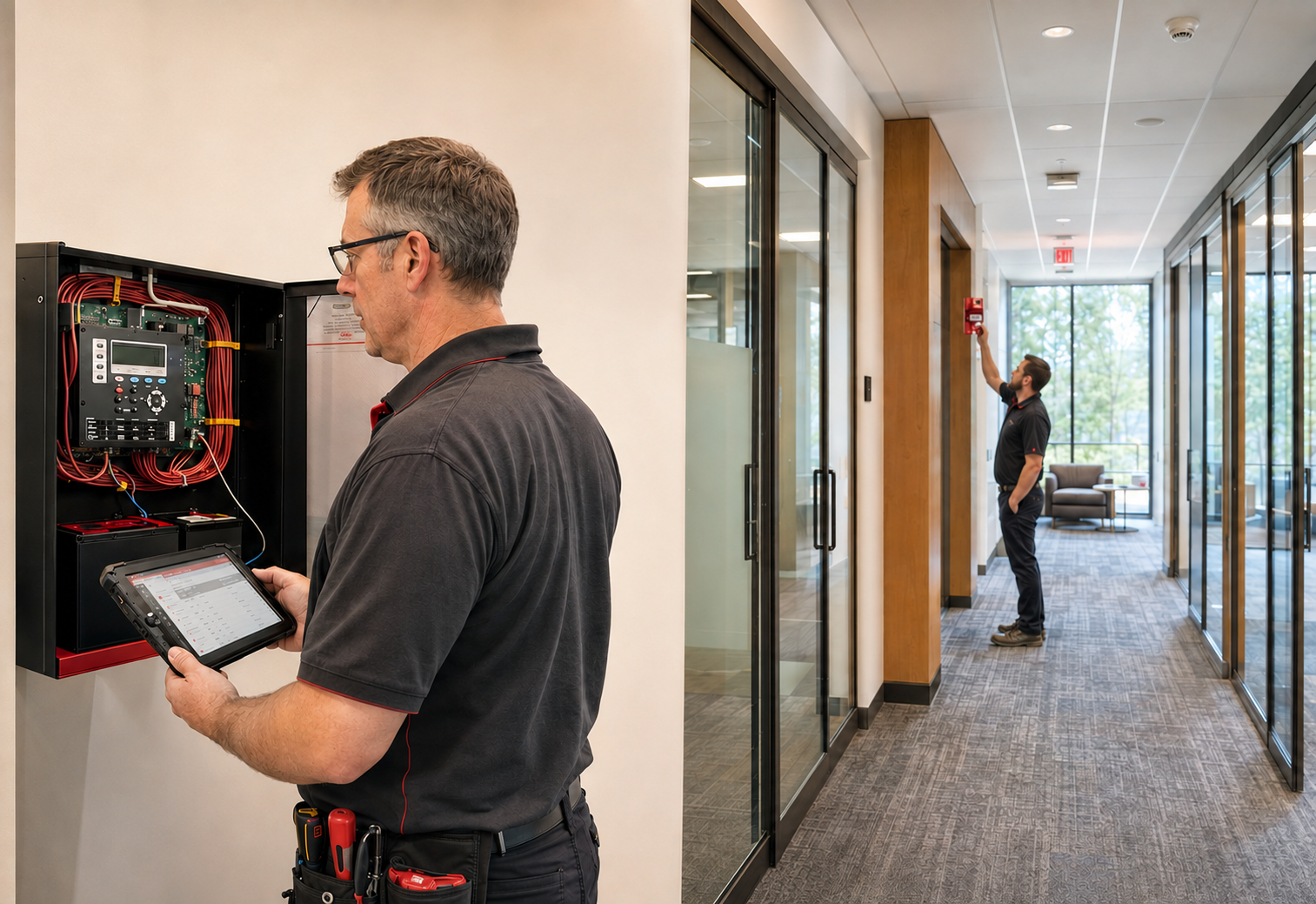
Why the Answer Is More Complicated Than “Test 10 Percent”
The figure most owners have heard is “10 percent.” It comes from a real rule in NFPA 72, the National Fire Alarm and Signaling Code—but the rule is narrower and, in some respects, broader than the shorthand suggests.
Under recent editions of NFPA 72, when site-specific programming is changed (the configuration tailored to your building—device addresses, labels, logic, timers, output groups, and sequences), the contractor must test 100 percent of the functions known to be affected by the change, plus an additional 10 percent of initiating devices that were not directly affected, up to a maximum of 50 devices, and revise the applicable Record of Completion. The NFPA Journal has published an official plain-language explanation of this rule.
Three points prevent the common misreadings:
The 10 percent sample is additional, not a ceiling. It supplements the affected-function testing; it never substitutes for it, and the 50-device cap limits only that sample—not the total reacceptance scope.
The rule applies to software changes, not every repair. NFPA technical committee annex material is explicit that a true like-for-like replacement—a fuse of the same type and rating, a like smoke detector, corrected wiring supervision—does not by itself invoke the additional unaffected-device sample.
There is a separate 10 percent method for circuit integrity. The NFPA 72 testing table contains a distinct circuit-integrity procedure involving faults and opened connections at a portion of devices on circuits within an acceptance or reacceptance scope. It has a different population and purpose than the software rule, and the two must not be merged into a single generic “10 percent rule.”
Four Types of Fire Alarm Testing—and Which One Applies After Service Work
Owners often use “inspection” and “test” interchangeably, but the code recognizes distinct activities with different triggers. Understanding the difference explains why a recent repair test does not replace your building’s periodic fire alarm inspection—and vice versa.
| Activity | Why it happens | Typical scope | Is this the post-service test? |
|---|---|---|---|
| Initial acceptance testing | A new system or major installation is ready for approval | Verifies the completed installation: devices, circuits, sequences, notification, monitoring, power, and documentation | Sometimes—a panel replacement or major upgrade can approach this scope |
| Periodic inspection & testing | Required on a recurring schedule for in-service systems | Frequencies and methods vary by component; many common functions are tested annually | No—it is a separate, ongoing obligation |
| Maintenance / service | A fault, deficiency, dirty detector, damaged device, or trouble condition is diagnosed and corrected | The work needed to maintain or restore the system | It creates the need to verify the serviced item, and can trigger reacceptance testing when equipment, wiring, hardware, or software changes |
| Reacceptance testing | An existing system is altered, repaired, reprogrammed, or otherwise changed | A targeted test based on what changed and which functions were affected | Yes—this is the subject of this article |
A contractor may perform periodic testing and reacceptance testing during the same visit, but the two should remain identifiable in the records. A post-repair reacceptance test does not automatically reset the building’s recurring inspection schedule.
A Decision Framework: Start With What Changed
Reacceptance scope follows the change, not the size or price of the replacement part. The framework below reflects how the NFPA 72 model code organizes the question.
Nothing was altered
Inspection, cleaning, resetting, or adjustment without changing hardware, wiring, or programming: verify the serviced item, the signal involved, and normal restoration.
Hardware, devices, or wiring changed
Test the changed item and every function it serves. Added devices are functionally tested; deletions require testing another device on the circuit; control-unit repairs require function and indicator checks plus the circuits served.
Software changed
Site-specific programming: 100% of affected functions plus the 10%-of-unaffected-initiating-devices sample (max 50). Executive software/firmware follows a separate sampling rule with critical-function verification.
Practical questions your alarm contractor should be able to answer before testing begins: Was the work truly like-for-like? Did any address, label, logic, timer, zone, output group, message, or sequence change? Which functions could behave differently as a result? Does the permit or AHJ require a test plan, witness, completion letter, or an updated Record of Completion?
Typical Reacceptance Scope by Type of Work
The table below shows a defensible starting point under the NFPA 72 model-code framework for the most common service and upgrade situations. The adopted edition, manufacturer instructions, system design, and AHJ determine the final scope for any specific project.
| Work performed | Typical baseline test scope | What makes the scope grow |
|---|---|---|
| Diagnose, clean, or adjust only (no hardware, wiring, or program change) | Verify the serviced component, the signal or condition involved, and normal restoration | The visit uncovers a deficiency, requires bypassing protection, or leads to a component or program change |
| Replace an initiating device like-for-like | Functionally test the replacement in place; verify correct signal, address/location display, expected sequence, off-premises receipt where applicable, and restoration | New type, address, base, circuit, zone, sensitivity setting, or any programming edit |
| Add or relocate an initiating device | Test the new or relocated device with the applicable physical stimulus and all affected outputs | Programming edits (usual on addressable systems), coverage or design changes, circuit modifications |
| Delete a device or appliance | Functionally test another device or appliance on that circuit to confirm the remaining circuit operates | The deletion must also be reconciled with approved coverage and design—the circuit check alone does not prove the removal was permissible |
| Replace a horn, strobe, or speaker like-for-like | Observe the replacement actually sound, flash, or play the expected message; verify settings and synchronization | Different candela, wattage tap, appliance type, circuit load, location, or programming |
| Add notification appliances | Functionally test each added appliance; verify approved location and settings; perform applicable audible/visual checks in the affected area | New or extended circuits, power supplies, synchronization, circuit calculations, programming |
| Repair circuit or pathway wiring | Test the affected devices and functions; verify required circuit supervision and restoration | Multiple branches disturbed, mapping or end-of-line changes, concealed damage, any software change |
| Replace batteries like-for-like | Verify correct type, connections, charger and power status, trouble/restoral behavior, and applicable battery test procedures | A failed capacity result, charger fault, or power-supply repair (which becomes a control-unit hardware change) |
| Repair or replace a control-unit board or NAC power supply | Perform the required control-unit function and indicator checks; test the circuits and features served by that hardware | Shared resources—a board serving hundreds of devices, configuration downloads, network changes, firmware updates |
| Replace the entire fire alarm panel | Broad control-unit, circuit, sequence, monitoring, notification, power, and emergency-function testing—often near acceptance-level scope | New site-specific and possibly executive software, compatibility and listing questions, permits and AHJ witness requirements |
| Change site-specific programming | Test every known affected function, plus 10% of unaffected initiating devices up to 50; revise the Record of Completion | Affected logic reaching notification, monitoring, elevators, HVAC, doors, or suppression |
| Update executive software / firmware | Apply the adopted-edition rule; the recent baseline is a 10% functional system test including at least one device on each input and output circuit, with critical functions verified | Updates affecting the database, drivers, network, communication paths, or listed compatibility |
The Scenarios Building Owners Ask About Most
Expand any scenario for a closer look at how a professional alarm company scopes the reacceptance test—and what does not automatically happen.
One smoke detector is replaced with the same model
The technician replaces the smoke detector and functionally tests it at its installed location using the appropriate method. The panel should display the correct address and alarm type; expected local and off-premises actions are verified; the detector and panel are restored to normal.
Not automatic: a true like-for-like detector replacement, with no site-specific software change, does not by itself require the additional 10 percent sample of unaffected initiating devices. NFPA’s explanatory annex material uses exactly this example to illustrate the code’s intent.
When it becomes broader: a different detector type, a changed address or zone, an edited program, a changed base or wiring, or a detector whose activation controls other building systems—each adds affected functions to the scope. A device can be physically similar while still creating a non-like-for-like system change.
A detector is added or relocated during a tenant renovation
The new or relocated device is tested with the applicable physical stimulus, and the contractor verifies the panel annunciation, signals, notification and control sequence, monitoring transmission, and restoration assigned to it by the approved design.
Why this usually invokes the software rule: addressable systems normally require a database edit for a new or moved device. Once site-specific software changes, all functions affected by that edit must be tested, the unaffected-initiating-device sample applies, and the Record of Completion is revised. Permitted drawings, coverage, and circuit loading may also come into play—simply returning the panel to normal does not close the project.
A detector is removed
Another device on the circuit is functionally tested to demonstrate that the remaining circuit still operates after the deletion.
Why “we removed it from programming” is insufficient: programming can suppress a missing-device trouble, but it cannot establish that the detector was unnecessary. The deletion must be reconciled with the approved design and required coverage, and a designer or the AHJ may need to approve the revised layout, with the program, drawings, and Record of Completion updated accordingly.
A horn/strobe is replaced, or new appliances are added
The replacement or added horn/strobe must actually operate: the technician confirms sound and flash, correct candela or tap settings, synchronization where required, compatibility, and normal restoration. A panel event or scan alone cannot prove a strobe flashed or a horn produced the correct output.
When it stays narrow: a listed, compatible, like-for-like appliance at the same location and settings, with no circuit or programming change, can be a localized reacceptance test.
When it grows: a change in candela, speaker tap, appliance type, synchronization, location, power supply, or circuit load can affect the protected area or an entire circuit—potentially requiring design calculations and broader audible and visual verification. If the change alters a notification zone, output group, message, or the panel database, the site-specific software rule applies as well.
A field circuit is repaired (for example, a ground fault)
The contractor tests the devices, appliances, and functions affected by the repair, verifies supervision of the affected circuit or pathway—which can include open, ground, short, communication-loss, end-of-line, mapping, or power-failure conditions—and confirms restoration.
Not automatic: correcting a wiring supervision problem without changing site-specific software does not trigger 10 percent testing of unrelated initiating devices. NFPA annex material uses this as another example of a targeted repair.
Why scope is sometimes uncertain: a cut cable, intermittent ground, water damage, or undocumented splice may affect more devices than the original trouble message suggested. A responsible contractor expands the tested area until it can reasonably establish which circuit and functions were disturbed.
A control-unit board, power supply, or the entire panel is replaced
Control-unit hardware repairs require the applicable function and indicator checks plus testing of the circuits and features that hardware serves. A NAC power supply repair involves the served notification circuits, supervision, AC and battery failure conditions, synchronization, and activation inputs; an SLC card involves the devices on that loop, circuit faults, mapping, and driven outputs. The test scope follows the failure domain—not the physical size or price of the part.
A full panel replacement is rarely a narrow service call. The new control unit must communicate with connected devices, supervise circuits, execute the approved sequence, operate notification, report off premises, transfer between primary and secondary power, and control applicable emergency functions. Because panel replacement usually includes new site-specific software—and often new executive software—the project can approach full acceptance-level testing, with the AHJ commonly expecting a permit, approved documents, a test plan, and closeout paperwork. There is no honest universal percentage for a panel replacement or system upgrade.
Site-specific programming is changed
Identify every function the change can affect and test all of them. Then test 10 percent of initiating devices that were not directly affected, up to 50, and revise the Record of Completion. Site-specific data includes device addresses and labels, zone assignments, input/output logic, timers, alarm-verification settings, notification groups, elevator recall matrices, door-release logic, fan shutdown, and monitoring routes.
A small edit can have a large test footprint. Changing the output logic attached to one initiating device may affect horns and strobes, elevator recall, door holders, HVAC shutdown, and monitoring. “Only one line changed” is not a meaningful measure of life-safety test scope. Even a label-only edit that changes no operational logic is still a site-specific database change in many systems; the contractor should verify the adopted edition, manufacturer guidance, and AHJ expectation rather than assume no test or documentation is required.
Executive software or firmware is updated
Executive software is the underlying control and supervisory program that manages the product’s operation—commonly associated with firmware or the panel’s operating program—as distinct from the building-specific configuration. The recent NFPA 72 baseline for an executive-software change is a 10 percent functional test of the system, including at least one device on each input and output circuit, with critical functions such as notification, emergency controls, and off-premises reporting verified.
This is a different rule from the 10 percent-of-unaffected-initiating-devices rule for site-specific software, and the two should never be collapsed into one. Where software is changed remotely, recent code language also requires a qualified person at the protected premises to perform and verify field testing—remote access does not eliminate onsite observation. Code language on firmware and update categories continues to evolve, so the adopted edition and the manufacturer’s release documentation govern.
A communicator or monitoring path is replaced
When a dialer, cellular, radio, or IP communicator is replaced—or a building moves off legacy phone lines—the alarm company places the supervising station on test, then verifies the applicable alarm, supervisory, trouble, and restoral signals; correct account and location information; primary and backup pathways; communication-path failure annunciation; and power conditions as applicable.
One successful alarm signal is not the whole test. It does not by itself prove that all required signal types, backup paths, failure conditions, and restorations work. An integral communicator may also involve panel site-specific or executive software, and the AHJ may require notice, a permit, or revised documents when the communication technology changes. Reliable fire alarm monitoring depends on verifying the full signal path, not a single event.
Elevator recall, door release, fan shutdown, or smoke control is changed
NFPA 72 governs the fire alarm interface device and its signaling performance: the contractor verifies that the correct input drives the correct relay or module, that supervision is maintained, and that the interface is restored after testing.
Why another trade may be needed: proving the interface output is not always the same as proving the end equipment performed correctly. Elevator recall can require an elevator mechanic; engineered smoke control can require HVAC and controls personnel and a special inspector; door and shutter operation can implicate other standards and the door-hardware contractor. End-to-end integrated testing may fall under NFPA 4 or another governing standard. Access-control release deserves particular care: depending on the approved design, a fire alarm may unlock doors, release magnetic locks, remove power from locking hardware, or release door holders—egress must remain available as required, and fail-safe versus fail-secure behavior is system- and door-specific.
Why Notification-Appliance Testing Can Add Substantial Labor
Owners are sometimes surprised that testing horns, strobes, and speakers takes longer than testing the detectors that started the project. The reason is simple: notification appliances must be observed in the occupied space. A panel history can show that a notification circuit activated; it cannot, by itself, prove that each strobe flashed, each horn sounded, or a speaker played an intelligible message in the protected area.
In a multi-tenant commercial property, appliances are distributed through corridors, restrooms, offices, conference rooms, storage rooms, mechanical areas, and tenant suites. In Cunningham’s field experience, the appliance count and access burden are often greater than owners anticipate. Reaching them can require advance notice to every affected tenant; keys, badges, or escorts; coordination around meetings, patient privacy, classrooms, retail hours, or production; and return visits when an area is inaccessible. High ceilings, atriums, and stairwells add ladders, lifts, and spotters—safe access is part of the labor.
Reacceptance methods can also be more involved than an annual operational check. Depending on the change and the protected area, audible notification can require sound-pressure measurements; voice systems can require sound-level and intelligibility evaluation; visual notification includes verifying approved locations and settings and confirming actual flashing; and synchronization or message changes can require observing groups of appliances together—in the affected area and as required by the approved test plan.
Good scheduling reduces disruption without removing the work: after-hours testing, floor-by-floor schedules, tenant notices, short audible windows, and radio communication between the panel and field technicians are standard practice. An inaccessible appliance is recorded as not tested or inaccessible—never assumed to pass because another appliance on the circuit worked.
How a Professional Alarm Company Scopes and Performs Reacceptance Testing
The strongest test scope starts with a written description of the change—not the assumption that the replacement part defines the entire job. Here is the process from first call to closeout.
-
Define the exact change
Identify the failed or altered component; whether the replacement is truly like-for-like; every wiring, hardware, software, and documentation change; the devices, circuits, floors, and building functions that could be affected; and whether a permit or AHJ witness is required.
-
Review system records and governing requirements
Drawings, the sequence of operations, the prior Record of Completion, device lists, program versions and backups, prior deficiencies, monitoring information, and manufacturer instructions all inform the plan. Missing or obsolete documentation is itself a practical risk—it can make a small change slower because the technician must first determine what the system was designed to do.
-
Build a test plan
For material changes, the plan states the work performed, affected functions and devices, any required unaffected-device sample, notification measurements, signals to the supervising station, circuits and power conditions to test, emergency-control interfaces and trades needed, impairment precautions, and AHJ witness and documentation requirements.
-
Coordinate the building, occupants, and monitoring facility
The system or account is placed in the appropriate test status, occupants and receiving facilities are notified, unintended dispatch is prevented, and interim protection is arranged when needed. “On test with the central station” and “system impaired” are not interchangeable concepts.
-
Perform the service and the reacceptance test
Qualified personnel make the repair or change, then perform the component-specific method and verify downstream behavior. The field test establishes actual operation—not merely the absence of a panel trouble. Larger tests typically pair a technician at the control unit with another in the field.
-
Restore and verify normal status
Bypasses, disconnects, disabled outputs, suppression interfaces, notification circuits, and monitoring are restored, and normal status is confirmed with the supervising station. Restoration is a distinct task: a successful test followed by a relay left disconnected is not a successful service visit.
-
Record passes, failures, deficiencies, and limitations
The record distinguishes what passed, what failed, deficiencies found but not corrected, inaccessible or untested items, simulated operations, and confirmation of restoration. A global “system passed” statement should never conceal device-level failures or untested areas. If a deficiency remains, the model code framework requires written notice to the owner or designated representative within the prescribed time, and impairment procedures apply when required protection is out of service without adequate compensating measures.
-
Complete permit closeout where applicable
For permitted work, the contractor assembles the required package—test report, Record of Completion, revised drawings, program documentation, completion letter or affidavit, and trade or special-inspection records—and submits it as the AHJ requires.
How Cunningham Documents Reacceptance and Inspection Testing
Cunningham Security produces inspection and testing reports organized in NFPA 72 format using BuildingReports FireScan, a device-specific inspection and reporting platform. Our technicians scan identified devices and record results at the device level—the device and its location, and whether it passed, failed, or has a deficiency—along with notes about defects, access issues, or corrective needs, and relevant system-level tests such as sound tests.
The resulting report gives the owner a clear, device-by-device account of the test scope and date, in a record suitable for owner review and AHJ submission where the AHJ accepts that format. Owners across our service area receive this same reporting on periodic inspections as well, which makes it straightforward to keep reacceptance records and recurring inspection records identifiable and organized.
After a permitted installation or alteration, Cunningham can assemble the BuildingReports inspection and test record with the applicable NFPA 72 Record of Completion, completion letters or affidavits when required by the AHJ, revised or as-built plans and sequence information, program and system documentation, associated monitoring and special-inspection records, and documentation of any outstanding deficiencies. This package is turned over to the owner and submitted to the AHJ, as required, to support final acceptance and permit closeout.
Permit Closeout and Local Codes in Maine, New Hampshire, and Massachusetts
Closeout requirements are local. As two Massachusetts examples: Natick’s fire alarm closeout requirements call for a Record of Completion and a completion or testing letter among the closeout documents, while the Boston Fire Department’s witness-test request requires contractor certification and supporting information for work presented for witness testing (Boston also maintains its own F-1 fire alarm licensing requirements). These are examples of the variation—not a claim that every jurisdiction uses the same package. No universal rule requires an AHJ witness for every minor repair, but permitted alterations, panel replacements, and major upgrades commonly require notice, witness, or closeout.
The adopted code edition varies by state as well, which is why an alarm company cannot responsibly cite “the latest NFPA 72” without checking the jurisdiction:
Massachusetts
The current Massachusetts Fire Code is based on NFPA 1 (2021 edition) with Massachusetts amendments, which generally brings in the referenced NFPA 72 edition; the building code, local AHJ, occupancy, and permit date can affect the controlling requirements.
Maine
The Office of State Fire Marshal’s current adopted-standards page lists NFPA 72, 2019 edition.
New Hampshire
The Division of Fire Safety’s current adopted-codes page lists NFPA 72, 2022 edition.
Fire Alarm Reacceptance Testing FAQ
Does every fire alarm service call require a full-system test?
No. The required scope follows the work performed and the functions affected. A true like-for-like repair can be narrowly tested, while a software change, panel replacement, or sequence change can require much more.
Does replacing one smoke detector require testing 10% of the system?
Not automatically. NFPA’s explanatory material states that a like-for-like smoke-detector replacement does not by itself invoke the additional 10 percent sample of unaffected devices. If programming or broader functions change, the software-change rules can apply.
What exactly triggers the 10% test?
For a site-specific software change, recent NFPA 72 editions require all known affected functions to be tested plus an additional 10 percent of unaffected initiating devices, capped at 50. Executive software uses a separate 10 percent framework, and the testing table contains a distinct 10 percent circuit-integrity method. The three should never be conflated.
Does the 50-device maximum limit the whole test?
No. It limits only the additional sample of unaffected initiating devices under the site-specific-software rule. It does not limit testing of affected functions, notification, circuits, interfaces, or other required work.
What is the difference between site-specific and executive software?
Site-specific software is the configuration tailored to the building—device assignments, labels, logic, timers, output groups, and sequence data. Executive software is the underlying control and supervisory program that manages the product’s operation, commonly associated with firmware or the panel’s operating program. Each has its own reacceptance rule.
Why test unaffected devices after a programming change?
The sample provides confidence that the edit did not inadvertently disrupt unrelated initiating-device operation or the system database. It is a safeguard against unintended software consequences.
Must every horn or strobe be tested after a change?
For reacceptance, the affected appliances, functions, and protected areas are tested based on the change, the approved test plan, and the AHJ. Notification appliances are not the population addressed by the 10 percent unaffected-initiating-device sample—notification affected by a change belongs on the 100-percent-of-affected-functions side of the rule, so a programming change touching all notification outputs can make the affected scope extensive.
Can testing be done after hours?
Often yes, when the owner, tenants, monitoring facility, and any AHJ requirements are coordinated. After-hours work reduces disruption but can add labor cost, and it still requires access to every relevant area.
Does reacceptance testing replace the annual inspection?
Not automatically. Reacceptance and periodic testing have different triggers and purposes. They can be coordinated on one visit, but the records should show which requirements and components were covered by each.
Does the fire department have to witness every repair test?
No universal rule requires an AHJ witness for every minor service repair. Permitted alterations, panel replacements, major upgrades, and certain local policies commonly require notice, witness, or closeout. When the requirement is unclear, ask the AHJ before the work.
What closes out a fire alarm permit?
It varies by jurisdiction. Common items include the final test report, the NFPA 72 Record of Completion, approved or as-built documents, sequence and program information, a completion letter or affidavit, monitoring confirmation, and final acceptance by the AHJ.
What happens if the test finds a deficiency?
The contractor documents it, notifies the owner or designated representative, and identifies corrective action. If the deficiency impairs required protection, the owner and contractor follow the applicable impairment and notification procedures.
Planning Fire Alarm Repairs, a Tenant Alteration, or a Panel Upgrade?
Cunningham Security can review the affected system functions, coordinate the required reacceptance testing, document device-level results in NFPA 72 format, and prepare the applicable closeout package for the AHJ—before the work is scheduled, so there are no surprises about scope. We design, install, inspect, service, and monitor commercial fire alarm systems throughout Maine, New Hampshire, and Massachusetts.
Request a Quote Request ServiceOr call us at (207) 846-3350
This article is educational content published by Cunningham Security Systems. It summarizes concepts from the NFPA 72 model-code framework and is not legal advice, engineering approval, or a determination by any authority having jurisdiction. The code edition and amendments adopted for a specific project, the approved design documents, the manufacturer’s instructions, and the AHJ determine the enforceable testing and documentation requirements. Commercial fire alarm testing should be performed by qualified personnel in coordination with the building and monitoring facility. For definitions of terms used in this article, visit our fire alarm and security glossary. Last reviewed August 4, 2026.
