
Glossary · Access Control
What Is an Electric Door Strike? How Door Strikes Work in Access Control
An electric door strike is an electromechanical device installed in a door frame. When an access control system authorizes entry — by card, mobile credential, PIN, intercom or push-button release — the strike releases its movable keeper so the lock’s still-extended latchbolt can pass out of the frame as the door opens.
Electric strikes are popular because they add controlled entry while preserving the door’s familiar mechanical hardware: the lever, the key cylinder, the closer and free mechanical exit from inside. They are also easy to misunderstand. This guide explains how a strike actually works, what fail secure really means, how fire-alarm integration is decided, and why frame preparation is specialized work — the details that matter when a strike becomes part of an access control system.
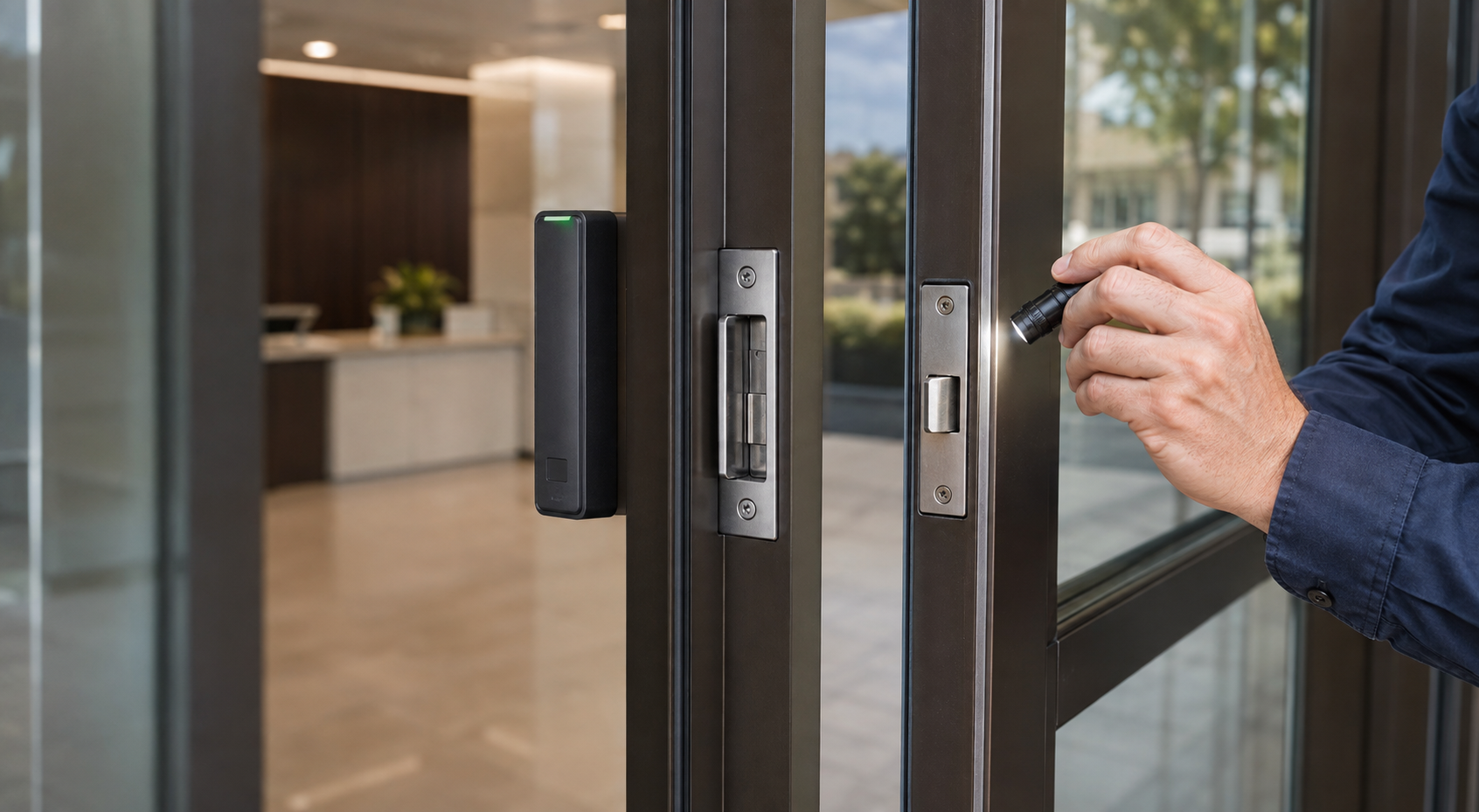
- Frame-side hardware Releases the latch — it does not retract it or replace the lock
- Keeps familiar hardware Lever, key cylinder, closer and mechanical exit stay in service
- Fail secure or fail safe Selected per door function — not interchangeable on listed openings
- One part of the opening Lock compatibility, listings, codes and the AHJ govern the design
Terminology
“Door strike” can mean two different things
In everyday hardware language, a door strike or strike plate is the fixed metal plate and pocket in the frame that receive a lock’s latchbolt. It has no powered release. An electric door strike is the electrified version: the pocket gains a movable keeper that an access control system can release on command. Several other electrified products are often confused with it, and the distinctions matter when planning a door.
| Term | What it actually is |
|---|---|
| Strike plate (passive strike) | The ordinary fixed frame plate and pocket that receive a mechanical latchbolt. No powered release. |
| Electric strike | A frame-mounted electromechanical device whose movable keeper releases a compatible latch or exit-device bolt when authorized. The latch itself stays extended. |
| Electrified lockset | A powered cylindrical or mortise lock in the door itself. Power changes the lock’s function rather than releasing a frame-side keeper. |
| Electric latch retraction (ELR) | Powered exit-device hardware that retracts the latch or latches, normally before the user opens the door. |
| Electromagnetic lock (maglock) | A powered magnet on the frame that bonds to an armature plate on the door. It does not depend on the lockset latch at all. |
Manufacturer training material such as Von Duprin’s Electric Strikes 101 draws the same central line: a strike lives in the frame and releases the latch without retracting it, while the other electrified products change hardware in the door.
Operation
What happens during a normal access event
At a typical card-reader door, the sequence looks like this:
- The door rests closed and mechanically latched. The strike’s keeper is in its secure state, blocking the latchbolt in the pocket.
- A user presents a credential — card, fob, mobile credential, PIN or biometric — or an intercom, receptionist button, schedule or other approved input requests release.
- The controller decides. The access control panel checks permissions, schedules and system logic. The strike itself never decides who is authorized; it executes the command it is given.
- On approval, the controller switches the strike’s power circuit through a relay or supervised output on an appropriately rated, listed supply.
- The keeper releases for a programmed interval. The user pulls or pushes the door open; the latchbolt stays extended and simply passes through the released keeper.
- The closer returns the door. The latch rides over the strike lip back into the pocket, the release interval ends, and the strike is secure again. Monitoring, where provided, lets the system distinguish normal access from forced-open, held-open or unlatched conditions.
Entry and exit are separate questions. On a common installation, the reader controls entry from outside while the inside lever or panic hardware retracts the latch mechanically for immediate exit. That is why a fail-secure strike can keep an exterior door locked during a power failure without trapping anyone inside.
Components
The parts of an electric strike
Names vary a little by manufacturer, but a typical strike combines a faceplate (the visible plate that adapts the body to the frame and latch preparation), a keeper (the movable jaw or lip that blocks or releases the latch), the pocket the latchbolt projects into, a ramped strike lip the latch rides over as the door closes, a solenoid or motor that converts the electrical command into movement, an internal locking mechanism that holds or frees the keeper according to the fail mode, and shims and adjusters that establish correct engagement. Optional monitoring switches can report latch presence or keeper state.
The small deadlatch matters more than it looks. Many cylindrical locks pair the main beveled latchbolt with a smaller auxiliary deadlatch. When the door is closed, the main latch enters the strike pocket while the auxiliary deadlatch should remain depressed against the keeper or strike surface — that is what prevents the main latch from being pushed back with a thin tool. If a strike is positioned or shimmed so the deadlatch falls into the pocket, the door can look locked while remaining vulnerable to manipulation, and it may bind. Preserving this relationship is one of the quiet skills of proper strike installation and adjustment.
Fail modes
Fail secure vs. fail safe
These terms describe the strike’s state when its power is lost — and only that. By themselves they do not describe how people exit the building.
| Fail secure (power to unlock) | Fail safe (power to lock) | |
|---|---|---|
| On loss of power | Keeper stays locked on the controlled-entry side | Keeper releases |
| Normal state | Briefly energized only to grant entry, on most models | Commonly energized whenever the door should stay locked |
| Typical objective | Preserve perimeter security through an outage | Release entry on power loss where the approved door function requires it |
| Exit from inside | Usually still free through the mechanical lever or panic hardware | Depends on the complete opening; normally also mechanically free with conventional latch hardware |
| Fire-rated doors | Generally the required configuration — it preserves positive latching | Generally not the listed fire-door configuration; verify the exact listing |
“Fail secure” does not mean people are trapped. It means the controlled-entry side stays locked when strike power is lost. A properly designed door still provides immediate mechanical egress through its inside lever or panic hardware — no electricity required. Allegion’s fail-safe vs. fail-secure explainer addresses the same common misconception.
Some strikes are ordered in one mode; others can be field configured. Field convertibility never overrides a listing — converting certain listed models to fail safe voids their fire or windstorm ratings, which is one of several reasons the exact product, configuration and installation sheet matter.
Selection
Common types of electric strikes
Strikes are best classified by the mechanical hardware and opening they must accommodate — not by faceplate size. The same lock at two different doors can still require different strike preparations because of frame material, depth, door thickness, gap, handing, pairs and mullions, existing preparation, hidden obstructions, environment and any fire or windstorm requirement. That is why “which strike fits?” cannot be answered reliably from a photo of the old faceplate alone.
| Type | Typical application and what matters |
|---|---|
| Cylindrical-lock strike | Bored commercial locksets. Latch projection, auxiliary-deadlatch position, frame preparation and gap drive the choice. |
| Mortise-lock strike | Commercial mortise locks. Larger, deeper case; the exact lock function and latch/deadbolt arrangement must match. |
| Deadbolt-capable strike | Selected mortise functions. Whether the pocket merely accommodates a deadbolt or actually releases it varies by model — never assume. |
| Narrow-stile / storefront strike | Aluminum storefront doors with Adams Rite–style deadlatches. Shallow extrusions, nearby glass and concealed components make this a specialist application. |
| Rim exit-device strike | Surface-mounted panic hardware. The exact latch design and projection, and frame or removable-mullion mounting, control compatibility. |
| Vertical-rod strike | Surface or concealed vertical-rod exit devices. Specialized configurations that are not interchangeable with ordinary rim strikes. |
| Surface-mounted strike | Less invasive than a full mortise, but usually still requires exact drilling, tapping, fasteners and wire routing. |
| No-cut retrofit strike | Fits a compatible existing ANSI frame preparation without enlarging the visible cutout. Internal obstructions and mounting/wire paths still need verification. |
| Gate / outdoor strike | Exterior gates and exposed openings. Outdoor suitability, corrosion, drainage, gate movement and preload tolerance become the deciding factors. |
| Fire-rated strike | Listed fire door and frame assemblies. The exact door, frame, hardware, fail-secure configuration, fasteners and maximum rating duration are all part of the listing. |
Not every strike requires a full mortise: surface-mounted and genuinely no-cut families exist. But most traditional strikes are precision cut-in hardware, which is why installation is a topic of its own below.
Field reality
Preload: why a powered strike may click but not open
Preload is pressure the latchbolt is already exerting against the keeper when the release command arrives. The solenoid can operate perfectly, yet the keeper remains bound by friction. Common sources include HVAC or stack pressure in the building, wind on an exterior door, smoke seals and weatherstripping, a poorly adjusted closer, sagging hinges, a warped door or frame, incorrect strike alignment or shimming — and people pulling on the door before authorization.
Some products are engineered to release under a stated amount of preload; Adams Rite, for example, publishes preload-capable configurations for certain series. That does not make every strike preload-tolerant, and it does not make a preload-rated product a repair for a damaged opening. The door must work correctly as a mechanical door first — a strike will not fix sagging hinges, a warped leaf or chronic misalignment.
A useful diagnostic rule: if the strike releases with the door open but not when the door is closed, investigate the opening’s alignment and preload before blaming the access control software.
Integration
Power, wiring and monitoring
There is no universal “strike power”
Common contemporary strikes run on 12 or 24 VDC, but AC, 16-volt and other configurations remain in the installed base, and current draw varies materially between models and voltages. DC operation is normally quiet apart from a click; AC operation produces the familiar buzz, and many AC coils are intermittent-duty parts that can be damaged if held energized. Wire gauge has to be calculated from the supply voltage, device load, conductor-loop distance, simultaneous loads and acceptable voltage drop — and the supply has to account for the controller, readers, every lock that may energize at once, standby batteries and any approved emergency sequence. Installers verify voltage at the strike, under load, using the exact unit’s current installation sheet, because long-lived product family names often span electrical revisions.
Monitoring is not one thing
Different switches answer different questions, and no single one proves a door is secure:
| Monitor | What it can establish | What it cannot establish alone |
|---|---|---|
| Door-position switch (DPS) | The door leaf is physically open or closed — the same job a door contact does in an alarm system | That the latch is engaged or the keeper is secure |
| Latchbolt monitor | A latch is present in the strike pocket | That the leaf is fully closed or the keeper is locked |
| Keeper / solenoid monitor | The release mechanism is in a defined secure or released state | That the door is shut and latched |
| Combined monitoring | Multiple independent conditions at once | Anything, without correct installation, programming and interpretation |
This is why a “door closed” signal on its own should never be read as “door secure.” Well-designed commercial security systems choose the monitoring the door actually needs and program the system to interpret it correctly.
Life safety
Do electric strikes unlock when the fire alarm goes off?
This is the most oversimplified claim about electric strikes on the internet, so it deserves a careful answer. It helps to separate three questions that can have different answers at the very same door:
- Can an occupant leave immediately from the egress side?
- Must the door remain closed and positively latched to protect a fire or smoke barrier?
- Does the approved emergency sequence require controlled-side unlocking — and if so, upon which event?
A fire alarm does not automatically require every electric strike to unlock. The correct emergency behavior depends on how occupants exit, whether the opening must remain positively latched, the type of electrical locking arrangement, the adopted code and the approved sequence of operations.
A very common exterior arrangement pairs a fail-secure strike with a lockset or listed fire-exit hardware that retracts mechanically from inside. Egress never depends on the strike, so there is often no code reason for an alarm to release it — and on a fire-rated door, keeping the strike fail secure helps the closer return the door to a positively latched condition, which the fire barrier needs. Industry guidance on the point is consistent: hardware associations note that when access control hardware limits ingress but does not affect egress, the door simply has to remain readily openable from the egress side, while the special electrically locked-egress code sections apply only when the locking system actually affects egress.
Other arrangements genuinely do require electrical release — upon fire-alarm, sprinkler or detection activation, loss of power, operation of a marked manual release, or a sensor or listed hardware switch — depending on which permitted locking section applies. The International Code Council’s overview of electrical locking systems in the means of egress distinguishes sensor-release, door-hardware-release, delayed-egress, controlled-egress and other arrangements rather than treating every access-controlled door alike. “Tied into the fire alarm” properly means an approved emergency-control interface operating according to a documented sequence — designed, supervised and tested under the locally adopted codes and standards — not an improvised connection, and not a blanket rule that every strike in the building unlocks.
Stair doors show why “unlock” and “release the strike” are not synonyms: where stair reentry is required, the usual objective is to make the stair-side lever operable while the fire door remains closed and positively latched. Electrified trim or an electrified lock function accomplishes that; releasing a fire-rated strike’s keeper could defeat the very latching the barrier depends on. There is even a legitimate opposite sequence — an alarm command removing a scheduled unlock so a fire door can close and latch. Firefighter access from outside is a separate design question again, solved variously with alarm-controlled unlock, key switches, key boxes or access control overrides as the fire department and AHJ direct.
Where an interface between the fire alarm and door hardware is required, it belongs in the approved sequence of operations and in ongoing test programs — the kind of sequence verification performed alongside fire alarm inspections and testing, coordinated between the access control designer, door hardware professional, fire alarm contractor and the local authority having jurisdiction.
A New England footnote. The electric strike’s apartment-entry role is old enough to be written into state law: Massachusetts M.G.L. c. 143, §3R requires — within its scope and exceptions — an automatically closing and locking main common entrance for apartment houses with more than three units, and expressly recognizes a lock with an electrically operated striker mechanism. Historical pedigree, though, is not a specification: occupancy, construction, adopted codes, product listings and the AHJ still control every individual door.
Listings
Standards and markings you may encounter
Product literature cites several distinct evaluations, and each proves something narrow. ANSI/BHMA A156.31 grades electric strikes through operational, strength, cycle and finish testing — the BHMA summary of the 2024 edition describes Grade 1 as including half a million operating cycles and a 1,500-pound static test, among others. UL 1034 covers burglary-resistant electric locking mechanisms; UL 294 covers access control system units and performance levels; and UL 10C covers positive-pressure fire testing of door assemblies and components — UL’s locking-configuration guide explains how the three relate. Outdoor and windstorm references add environmental and pressure conditions.
Two cautions keep those marks honest. A rated strike does not make an unlisted or improperly modified opening fire rated — the complete assembly and the permitted field preparation matter, which is why the Steel Door Institute publishes SDI-118 for field modification of fire-rated steel doors and frames. And a “1,500-pound” component claim is not the strength of the doorway: frame anchors, door construction, latch projection, hinges, mullions, fasteners, the wall and the quality of installation all remain in the load path. Security is a system property, not a spec-sheet number.
Comparison
Electric strike vs. magnetic lock
Both can control entry, but they secure a door in fundamentally different ways — and neither is categorically better or more secure.
| Question | Electric strike | Magnetic lock |
|---|---|---|
| How it secures the door | Blocks the existing mechanical latch at the frame | Powered magnet bonds to an armature plate on the door |
| When access is granted | Keeper releases; the extended latch passes through | Magnet de-energizes and releases the armature |
| Fail mode | Available fail secure or fail safe, by model and configuration | Inherently fail safe — no power means no bond |
| Exit at a typical door | Inside lever or panic hardware retracts the latch mechanically | Requires a code-compliant electrical release arrangement — sensors, hardware switches, manual release and power-loss behavior per the permitted locking section |
| Fire-door positive latching | A listed fail-secure strike works with the mechanical latch to preserve it | A maglock by itself provides no positive mechanical latch |
| Key override | The existing lock and cylinder commonly remain usable | The magnet has no key cylinder; override depends on separate hardware |
| Appearance and fit | Often discreet in the jamb; needs compatible latching hardware | Magnet and armature can be visible; often the practical answer for all-glass, sliding, bi-swing, high-cycle or specialty openings |
A fair summary: choose a strike when preserving a compatible mechanical latch, key override, familiar hardware, direct mechanical exit or a fail-secure perimeter matters most. Consider a maglock when door geometry, glass, movement, traffic or the absence of compatible latching makes it the more appropriate listed solution — manufacturer application guidance such as Securitron’s discussion of where maglocks fit identifies exactly those specialty conditions. The complete opening, its listings and the approved release controls determine which is right, door by door.
Installation
Why professional frame preparation matters
A conventional mortised strike needs far more than a rectangular hole. The installer must establish the actual latch centerline and depth, preserve enough frame material for mounting, route wiring without damage, avoid hidden obstructions, keep the faceplate flush, align the keeper and auxiliary deadlatch, and protect any fire or windstorm listing that applies to the opening. An overcut or misplaced cut can weaken a narrow jamb, leave a permanent visible gap, interfere with the stop or weatherstrip, create chronic preload or relatching failures, sever concealed wiring, breach corrosion protection, or invalidate a rated assembly — sometimes at the cost of door or frame replacement. Wood can splinter; hollow-metal frames may conceal grout, welded anchors or conduit; aluminum storefront extrusions may offer only a narrow channel shared with glass stops, fasteners and closer components.
Adjoining glass deserves its own warning. Tempered and heat-strengthened glass resists many surface loads, but its edges remain vulnerable — glazing manufacturer Vitro’s technical guidance on glass breakage reports that edge damage can cut glass strength by more than half, and tempered glass cannot be field-cut after heat treatment. On a storefront, the visible metal beside the door is not necessarily an empty cavity: a drill bit, long screw, blade or shifted glass stop can strike or load a concealed glass edge, and the resulting failure can be immediate or delayed. Careful work around glass is non-negotiable.
Electric-strike frame preparation is normally performed by a qualified locksmith or experienced door-hardware technician, and a complete opening can also involve the access control integrator, a licensed electrician, a fire alarm contractor, a glazier and the authority having jurisdiction, depending on the door. Cunningham has a small number of team members capable of this specialized work and coordinates with locksmiths, glaziers, fire alarm professionals or other trades when the opening requires them. The professional workflow always starts the same way: survey the entire opening, correct mechanical defects first, select the exact compatible product, prepare only what the listing and instructions allow, verify voltage under load, adjust for correct latch and deadlatch engagement, then commission and document the door — including the emergency sequence, where one applies.
Checklist
What a professional confirms before selecting a strike
Existing hardware
Exact lock or exit-device model; cylindrical, mortise, deadlatch, rim or vertical-rod type; latch shape, centerline, projection and deadlatch; key function; inside egress hardware; closer condition.
Door and frame
Hollow metal, wood, aluminum or gate construction; frame depth, backbox, anchors and wire path; handing, swing, pairs and mullions; nearby glass; existing preparation; exposure.
Required operation
Fail secure or fail safe; schedules and unlock duration; expected cycles, abuse and preload; quiet DC or audible AC; key override and free egress; any emergency sequence.
Power and listings
Exact voltage, current, AC/DC and duty; supply and standby capacity; monitoring; controller output rating; fire, windstorm, outdoor, UL 294/1034 and BHMA requirements; AHJ approval.
Background
A short history, and the brands you will see
Electric strikes developed from late-19th-century electric door openers that let someone release an entrance remotely — a familiar convenience in apartment buildings long before modern access control. The precise origin is murkier than most retellings admit: Allegion’s published histories trace the device to an 1886 D. Rousseau electric door opener, the Hagley Museum’s corporate-archive research credits an 1884 patent by Robert Edwards, and an 1883 Scientific American advertisement appears to promote yet another maker’s electric door opener. Whoever deserves the credit, the technology evolved through solenoid-operated remote release into today’s standardized, monitored, fire-rated and access-control-connected hardware, with modern families addressing no-cut retrofits, narrow storefronts, preload tolerance, outdoor exposure and detailed monitoring.
Established manufacturers a reader is likely to encounter include HES and Adams Rite (ASSA ABLOY), Von Duprin and Schlage (Allegion), Trine, SDC, RCI (dormakaba), Camden Door Controls and, in institutional and detention work, Folger Adam. Within any of these lines, a different faceplate, keeper option, voltage, monitor or suffix can change both compatibility and listing — brand recognition never replaces opening-specific selection.
Service
Common symptoms, and what they usually mean
| Symptom | What to investigate |
|---|---|
| Releases with the door open, not closed | Preload, hinge sag, latch/keeper misalignment, closer adjustment, seals, building pressure |
| Weak or chattering buzz | Low voltage or current at the strike, conductor voltage drop, undersized supply, wrong AC source, mechanical bind |
| No sound on a DC strike | May be perfectly normal — verify voltage under load, polarity and keeper action before assuming a fault |
| Door will not relatch | Door not fully closing, a constant release output, a stuck keeper, wrong mode, or latch-to-strike misalignment |
| Strike unusually hot | Over-voltage, an intermittent-duty coil held energized, or a wiring or configuration fault — remove from service and diagnose |
| Looks locked, but the latch can be slipped | The auxiliary deadlatch may be falling into the pocket instead of staying depressed — a positioning and shimming problem worth immediate attention |
Routine care follows the manufacturer’s instructions, not habit: leading makers advise against indiscriminate lubrication because oil attracts dirt into the mechanism — Trine’s field troubleshooting guide specifically says not to lubricate the solenoid. Doors with electric strikes also belong in the building’s normal inspection rhythm: mechanical operation, monitoring, power-loss behavior and any required alarm sequence should keep being tested for as long as the door is in service.
Questions
Electric door strike FAQ
Does an electric strike unlock the door or retract the latch?
Neither, strictly speaking. The strike releases its frame-side keeper so the lock’s still-extended latchbolt can pass through as the door is opened. The latch is not retracted, and the lock itself is not changed. Products that retract the latch — electrified locksets and electric latch retraction exit devices — are different hardware.
Can you exit through a fail-secure electric strike during a power outage?
At a properly designed door, yes. Fail secure describes only the controlled-entry side: the keeper stays locked when power is lost. Exit from inside typically relies on the mechanical lever or panic hardware, which retracts the latch with no electricity at all.
Do electric strikes unlock when the fire alarm goes off?
Not automatically, and not universally. Many fail-secure strike doors provide mechanical free egress from inside while staying secure from the entry side, and fire-rated openings often must remain positively latched. Some locking arrangements do require release upon alarm, sprinkler, detection or power-loss events. The adopted code, the approved sequence of operations, product listings and the authority having jurisdiction determine the required behavior for each door.
What is the difference between an electric strike and a maglock?
A strike releases the door’s existing mechanical latch at the frame; a maglock holds the door with a separate powered magnetic bond. Strikes can be fail secure or fail safe and preserve key override and mechanical exit; maglocks are inherently fail safe and generally require additional code-prescribed release controls. Neither is categorically more secure — the right choice depends on the complete opening.
Can any electric strike work with any lock?
No. The strike must match the exact latch type and geometry, frame material and depth, door gap, handing, fail mode, electrical characteristics and any required listing. Even within one product series, a different faceplate or option can change compatibility, which is why professionals select from the actual lock model and a survey of the opening — not from a photo of the old faceplate.
Does every electric strike require cutting the frame?
No, though most traditional models are precision cut-in hardware. Surface-mounted strikes — common with rim exit devices — and genuine no-cut retrofit models for compatible existing frame preparations also exist. Surface and no-cut products still typically require accurate drilling, tapping, fastening and wire routing, so “less invasive” does not mean casual.
Can an electric strike be installed in an aluminum storefront frame beside glass?
Often, with the right narrow-stile product and a careful survey — but this is one of the riskier applications. The narrow extrusion may conceal glass edges, glass stops, anchors, wiring or closer components, and edge damage can dramatically weaken tempered glass. Where the frame cannot safely accommodate a strike, a different listed approach may be the better answer.
Why does my electric strike click or buzz but not release?
The most common culprit is preload: the latch is pressing against the keeper because of building pressure, wind, seals, closer problems, hinge sag or misalignment, so the keeper binds even though the solenoid operates. Low voltage at the strike under load is the other frequent cause. If it releases with the door open but not closed, look at the opening first, not the access control software.
Are electric strikes fire-rated?
Specific models and configurations are listed for use on fire-rated openings — generally in fail-secure form, so the door can stay positively latched. The rating belongs to the complete listed assembly and its permitted installation: a rated strike does not make an unlisted or improperly modified opening fire rated, and field-converting a listed strike’s fail mode can void its rating.
Who should install an electric strike?
Frame preparation is normally the work of a qualified locksmith or experienced door-hardware technician, with the access control integrator handling system design, wiring, programming and commissioning — and, where the door requires it, a fire alarm contractor, electrician, glazier and the local AHJ involved as well. Cunningham has a small number of team members capable of this specialized preparation work and coordinates the other trades when an opening calls for them.
Thinking about controlled entry for an existing door?
The right answer starts with the opening, not the catalog. If you are considering access control for a building in Maine, New Hampshire or Massachusetts, we can evaluate the doors, the hardware and the life-safety requirements and recommend what actually fits — whether that turns out to be an electric strike or something else entirely.
This glossary article is educational. It is not installation instructions, a product specification or project-specific code advice; the adopted codes, product listings, approved plans and the local authority having jurisdiction govern each opening. Content reviewed August 2026.
