
Flock Cameras in Maine: What They Record, Where They’re Used, and Why Towns Are Pulling Back
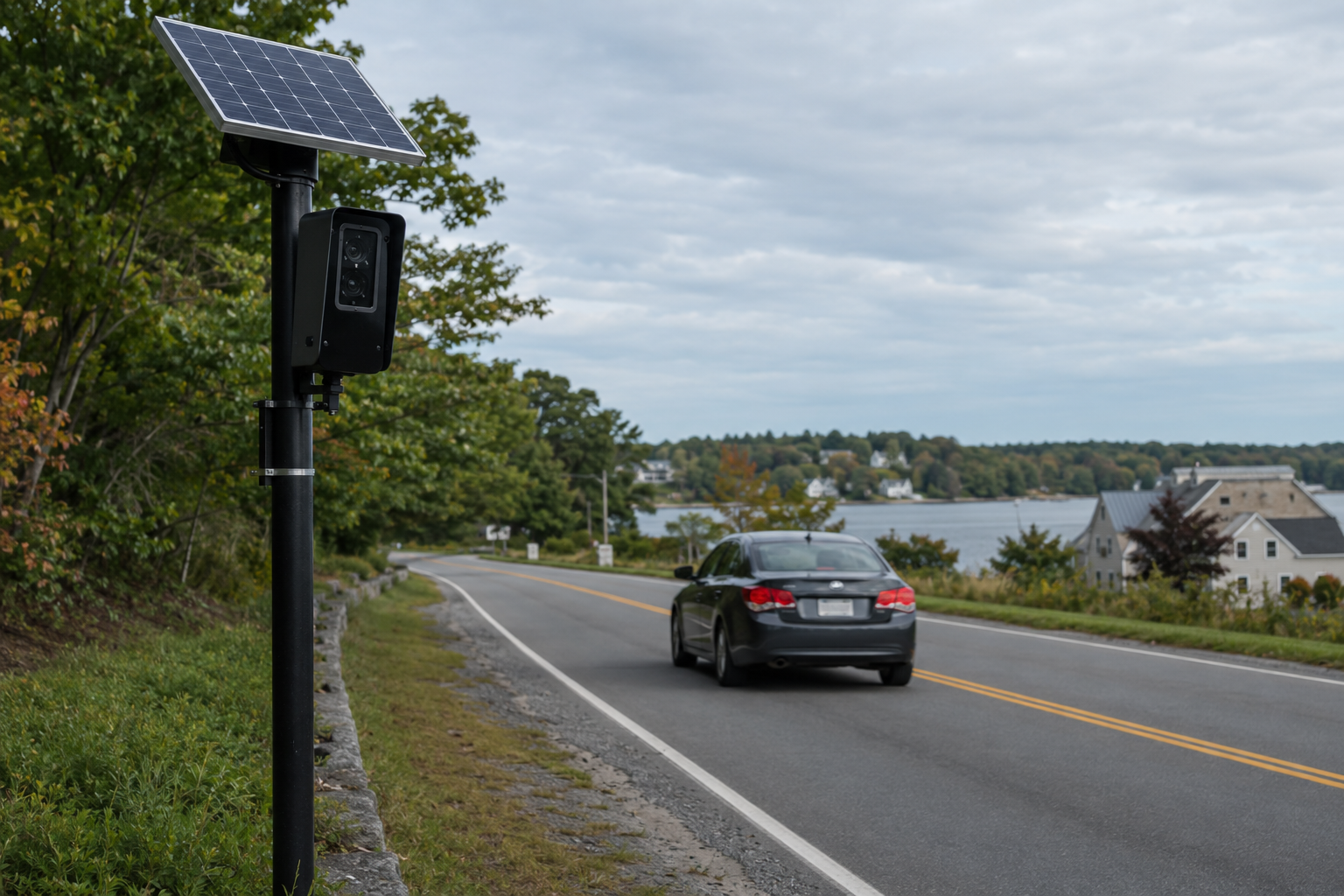
A small solar-powered camera along a Maine road can photograph thousands of passing vehicles in a single hour. It does not know who is driving, but it records the plate, a rear image of the vehicle, and the time and place of the sighting — and it makes that record searchable afterward. At the start of 2026, police in five Maine municipalities were publicly using cameras from Flock Safety. By mid-August, only Lewiston and York could be verified as active Flock users. South Portland removed all seven of its cameras, Auburn's system went inactive, Falmouth authorized a switch to a different vendor, and Sanford canceled its trial before it began.
This guide explains what the cameras actually record, where every Maine program stands, what Maine's unusually specific license-plate-reader law says, and how these public networks differ from the private security cameras on your own home or business.
Maine at a glance — August 15, 2026
- Verified active Flock systems: Lewiston and York
- Inactive, hardware last reported still on poles: Auburn
- Leaving Flock for Axon plate readers: Falmouth
- Ended, all cameras removed: South Portland
- Approved a trial, then canceled before deployment: Sanford
- Maine's ordinary retention limit for plate-reader data: 21 days
Where every Maine Flock program stands
Flock's Maine footprint changed dramatically during 2026, and stale numbers still circulate widely. The table below reflects the best-supported, dated information for each community as of August 15, 2026. Camera counts are reported with the date they were published, because departments, reporters, and city records have used conflicting figures.
| Community | Status | Cameras (dated count) | Data sharing | Source |
|---|---|---|---|---|
| Lewiston | Operating | 11 installed + 3 planned (Feb. 2026); later city purchasing records reference 13 units. No single verified current total. | Searches require an offense, reason, and case number and are auditable; police say no sharing with federal immigration authorities. | WGME I-Team; City update, Jul. 2 |
| York | Operating | Six reported (Sep. 2025); four reported (Oct. 2025). Current policy names Route 1 and Spur Road corridors but no total. | No direct outside-network access; external requests need supervisor approval and case details; monthly audits; 21-day retention (Policy O-68, May 2026). | Town Flock page; Policy O-68 |
| Auburn | Inactive | Seven readers plus one movable camera originally (2025); six poles reported still standing Jul. 31. | Not in use — council declined renewal funding. A certified citizen initiative to ban Flock now awaits council action or a public vote. | Sun Journal, Jul. 31; News Center Maine, Aug. 14 |
| Falmouth | Switching to Axon | Four Flock readers on two corridors during its trial; at least one Route 100 pole still awaited removal Aug. 13. | Shared with several neighboring departments during the trial; officials describe the new Axon arrangement as locally controlled with no federal sharing. | Resolution 130-2026; WGME, Aug. 13 |
| South Portland | Ended & removed | Seven fixed cameras; all seven removed and accounts closed by Jun. 22. | Sharing was narrowed to Maine agencies before the exit; all use and sharing stopped Jun. 11 after a council review of network search activity. | Official city ALPR page |
| Sanford | Never deployed | Six proposed for a free 60-day trial; no verified installation. | Council approved the trial 4–3 in September 2025, then rescinded it unanimously the following month. | Press Herald, Oct. 31, 2025 |
There is no reliable single “Maine has X Flock cameras” number. Counts changed through the year, poles can remain after service ends, and crowdsourced camera maps have proven unreliable — in August, the Bangor Daily News visited nine map-plotted “Flock” locations in Bangor and found ordinary private cameras and traffic sensors; city officials said Bangor operates no plate-reader system at all.
Two other facts keep the Maine picture honest. First, leaving Flock does not necessarily mean leaving license-plate readers: Falmouth authorized a 10-year Axon technology package that includes plate readers, and police agencies in Hancock County have been building a separate Motorola-based reader network serving Bar Harbor and Ellsworth, with Bucksport participation planned, per the Bangor Daily News. Second, a May records review reported by the Portland Press Herald found no Flock use in Portland, Saco, Ogunquit, Kittery, or Brunswick.
What is a Flock camera?
Flock Safety is an Atlanta company founded in 2017 that began by selling inexpensive, solar-powered, cellular-connected license-plate readers to neighborhoods, then expanded aggressively into municipal policing. It has since grown into a broad public-safety platform: by 2026, the company and national reporting described more than 120,000 cameras across 49 states and roughly 20 billion vehicle scans per month, serving more than 5,000 law-enforcement agencies along with thousands of HOAs and businesses. Those are the company's own figures — Flock is privately held, so they are not audited public disclosures.
The product most people mean by “Flock camera” is the fixed automated license-plate reader, or ALPR. It is sold as an annual subscription that bundles the hardware, installation, LTE connectivity, cloud storage, software, and maintenance. Maine contracts have run roughly $2,500 to $3,500 per camera per year: Falmouth's four-camera trial cost about $14,000, South Portland's seven cameras totaled $43,000 over two years, and Lewiston's council authorized a $69,900 sole-source purchase.
The subscription model is a large part of why the cameras spread quickly — and why several Maine deployments later stalled. Federal grants covered the first year in Lewiston, Auburn, and South Portland, which meant systems could launch without an immediate local tax impact. The public debate often arrived only when recurring local funding came due. Auburn's system went dark for exactly that reason: the roughly $24,000 annual renewal did not make the adopted budget.
What does a Flock camera actually photograph?
A standard fixed Flock reader captures several still frames as a vehicle passes, reads the plate, and builds what the industry calls a “vehicle event” — a time- and location-stamped record of one sighting. Under Flock's own license-plate-recognition policy, a single read can include:
- the plate photo and the machine-read plate characters;
- the issuing state;
- a rear image of the vehicle;
- searchable vehicle attributes — make, model, color, and body type;
- visible features such as a roof rack, bumper sticker, dent, or missing hubcap;
- the time and the camera's location.
The system can also classify temporary, partial, obscured, or missing plates. The plate-and-state combination is compared against NCIC hot lists and locally entered alerts — stolen vehicles, missing or endangered people, wanted subjects — and a sufficiently confident match pings officers in real time. Authorized users can also run historical searches of stored reads by full or partial plate, location, timeframe, or vehicle description.
The key concept is aggregation. One roadside photo is a point-in-time sighting. The privacy debate is about what thousands of cameras, weeks of stored reads, and cross-agency search can do together: reconstruct portions of where a vehicle has traveled. During Falmouth's trial, a dated portal snapshot showed four cameras logging 118,011 vehicle detections in 30 days. A single Lewiston camera on College Street reportedly recorded more than 3,600 plates in one hour.
Does a Flock camera record video, audio, or faces?
For the standard license-plate reader — the product every verified Maine police deployment used — the answer is no on all three counts. Flock states the standard LPR does not record continuous video, does not record audio, does not perform facial recognition, does not measure speed, and does not issue traffic tickets. South Portland's official description of its former system matched this: rear-facing still-image cameras recording plates, vehicles, and visible characteristics, not video or faces.
That answer comes with an important caveat: “Flock camera” is an imprecise term, and the company sells much more than plate readers. Its Condor product records live and stored video and can detect people. Its Raven product is an acoustic sensor marketed for gunshot detection — an audio product. Its FreeForm search can scan enabled video for people by clothing, build, and activity descriptions, which is not facial recognition but is people-focused analytics. None of these broader products was part of a verified Maine municipal deployment, but the distinctions matter anywhere a “camera contract” is on a council agenda.
The most accurate one-sentence summary: the roadside readers Maine departments used are designed to identify vehicles, not people by face — and Flock separately sells video and analytics products with broader capabilities.
Audio recording by private security cameras raises its own legal questions, which differ by state — we cover the strictest nearby example in our guide to whether security cameras can record audio in Massachusetts.
Can a Flock camera identify the driver?
Not by itself. A plate read identifies a vehicle event, and nothing in the image tells the system a person's name, age, or address. Even Lewiston police put it plainly to WGME: the department has no idea who is driving — it has the vehicle, which gives investigators a starting point. Officers can then connect a plate to registration records through separate law-enforcement databases, but that identifies the registered owner, who may not have been behind the wheel.
This is also why every credible policy — including Maine State Police's and York's — treats a hot-list alert as a lead rather than proof. The alert can be wrong in two different ways: the software can misread a plate or state, or the plate can be read perfectly while the underlying hot-list entry is stale, erroneous, or about the owner rather than the current occupant. Sound practice requires an officer to visually compare the plate, state, and vehicle description and confirm the entry is still active before acting on it.
Town by town: how five Maine programs took five different paths
Lewiston — the clearest expansion case
Lewiston received a $70,000 federal grant in June 2025, ran a fall trial, and in December authorized a $69,900 sole-source Flock purchase. Police attribute real results to the system: assistance in shooting investigations, stolen-vehicle cases, a property-theft ring, and domestic-violence incidents, and a July city update said the technology played some role in resolving 13 of 19 gun-violence incidents in the first half of 2026. Those are police attributions of assistance, not proof the cases could only have been solved this way — a Lewiston lieutenant acknowledged some might have been solved by other means, but more slowly. Public comments in city minutes raised concerns about immigration-adjacent neighborhoods, broad network access, and one attempted camera placement on condominium property without the association's permission.
York — keeping the cameras, narrowing the network
York is the best Maine example of a town trying to keep the technology while tightening the rules around it. Its Policy O-68, effective May 7, 2026, requires an offense, case number, and reason for historical searches; bars use for immigration enforcement, ordinary traffic enforcement, harassment, or targeting based on protected characteristics; blocks direct outside-network access; requires supervisor approval for external requests; mandates multi-factor authentication and monthly audits; requires human verification of any hit before action; and sets 21-day ordinary retention. Notably, the policy states an officer does not need reasonable suspicion or probable cause merely to use the system — a reminder that a case code and a legitimate purpose are not the same thing as a warrant.
Auburn — inactive system, active politics
Auburn's seven readers and one movable camera went up in roughly August 2025 under a $25,000 Homeland Security grant that, under the city's process at the time, did not require a separate council vote. The police chief credited the readers with helping in about 20 cases, but the roughly $24,000 renewal was left out of the adopted budget, and by July 31 the cameras were reported inactive with six poles still standing. Three state legislators then organized a citizen initiative to ban Flock in the city; the clerk certified 1,647 valid signatures on August 14, which forces the council to enact the ordinance or send it to voters under the city charter. Because the system is already off, the vote is mainly about whether Auburn can use Flock in the future.
Falmouth — leaving the vendor, keeping the capability
Falmouth ran a one-year, four-camera Flock trial covering the Route 100 and Route 1 corridors, then on June 1 unanimously authorized a 10-year Axon technology agreement — reported at about $140,000 per year after a lower first year — that expressly contemplated terminating Flock. Town officials described the new arrangement as offering more local control and no federal sharing. Falmouth is the cleanest proof that a “Flock exit” can actually be a vendor switch: the plate-reading capability continues under a different logo, which is why the underlying policy questions do not end when one company's name comes down off the pole.
South Portland — the definitive exit
South Portland is Maine's best-documented case because the city published its full history, camera locations, policy, results, audit, and removal status on an official ALPR page. Its seven cameras produced results officials stood behind — police cited help identifying an online predator who had abducted a preteen, locating suspects in a $100,000 bank robbery, finding a shooting suspect, and locating a missing diabetic person who needed medication — and the city reported no local misuse.
What changed the outcome was the network math. The city's June 11 audit review found roughly 4.65 million outside “network search events” had touched the South Portland camera group over 16 months. That figure needs careful reading: it does not mean outside agencies viewed millions of South Portland images. A single broad search can sweep South Portland's dataset in as one of many eligible networks, and the logs could not show whether any image was actually displayed or downloaded. About 99.96% of the search reasons contained no immigration-related terms, and the city found none of its own searches involved immigration enforcement, abortion-related investigation, or First Amendment surveillance. The council still voted 5–2 to end the program — not because of proven abuse, but because the practical reach of the network was far broader than the original purchase discussion had conveyed. Flock confirmed all seven cameras were removed and every city account closed by June 22.
Sanford — rejected before it began
Sanford's council approved a free 60-day, six-camera trial by a 4–3 vote in September 2025, then reversed itself unanimously three weeks later after objections about privacy, potential federal access, and the limited public process. No verified Flock deployment ever went live there.
Are Flock cameras legal in Maine?
Maine is one of the few states with a specific license-plate-reader statute — and it passed seven years before Flock existed. 29-A M.R.S. §2117-A, enacted in 2010, works in an unusual way: it starts with a general prohibition on ALPR use by anyone, then carves out specific government exceptions. State, county, and municipal law enforcement may use plate readers for public safety, criminal investigations, and compliance with the law. MaineDOT and the State Police have narrower transportation-related exceptions. Use must be for the official and legitimate purposes of the user's employer, the collected data are confidential, ordinary data may not be stored more than 21 days, and a violation is a Class E crime.
So the direct answer is yes — Maine law expressly permits police plate readers, within limits. The genuinely unsettled question is what those limits mean for a modern, cloud-hosted, networked system. The statute says information entered by an officer must rest on “specific and articulable facts.” Police and municipalities read the law as permitting the collection of passing vehicles and later searches tied to legitimate documented investigations. Civil-liberties advocates question whether language written in 2010 — when the familiar model was a cruiser-mounted reader checking plates against a list — was ever meant to authorize bulk, suspicionless collection first and retrospective network searching later. No controlling Maine appellate decision has resolved that question for a dense Flock-style network.
Courts elsewhere have generally upheld narrow, targeted plate-reader queries involving a handful of sightings while repeatedly warning that a denser, longer-term, cross-jurisdiction system that reconstructs a person's routine movements could cross a constitutional line. Massachusetts' highest court said as much about a small bridge-camera network in 2020, and a federal court reviewing Norfolk, Virginia's 176-camera Flock system reached a similar “not yet, but maybe at greater scale” result in January 2026, now on appeal.
One more feature of Maine's law matters for property owners: because the statute begins with a general prohibition and its exceptions are governmental, Maine is not an obvious market for the private, HOA-style plate-reader model that fueled Flock's early growth elsewhere. A conventional security camera that incidentally records a passing car is not an ALPR under the statute — the definition requires the camera-plus-algorithm system that converts plate images into computer-readable data. But a business considering automated plate recognition in Maine should get state-specific legal advice first. In one 2026 episode, apparent plate readers at private corporate properties in Maine were removed after a Press Herald investigation; no violation was admitted and no prosecution was reported, but the episode shows the private-use prohibition has teeth.
How long can Maine police keep plate-reader data?
Ordinary scans — the background reads that never match anything — may not be stored more than 21 days under Maine law. Data that qualify as intelligence or investigative records, such as reads preserved as evidence in a documented case, can be retained longer under applicable law and policy. Maine State Police's own ALPR policy, General Order E-140, uses the same 21-day ceiling and adds visual-verification and restricted-access requirements, and York's municipal policy mirrors it.
Nationally, Flock historically promoted a 30-day rolling window. On August 13, 2026, responding to a year of criticism, the company announced it would recommend and default new deployments to seven days, with an “Evidence Mode” for material tied to investigations. Existing customers keep their locally approved periods unless they choose to change — so Maine's 21-day settings did not automatically become seven-day settings overnight.
Who else can search the data?
This is the question at the center of every Maine controversy, and the honest answer is: it depends entirely on how each customer's sharing is configured at that moment. Flock is best described as a customer-controlled but vendor-operated federated network. Each agency generates its own dataset and can permit a neighboring department, a regional group, a statewide group, or a wider network to query eligible reads. A single search can then sweep across many participating datasets at once. The system is neither one giant database automatically open to every officer in America nor a set of isolated town cameras — its reach is whatever the sharing graph says on a given day.
South Portland's audit made that abstraction concrete for Maine: millions of outside network search events had touched its camera group, mostly as one dataset among many in broad queries, even though the city had already narrowed reciprocal sharing to Maine agencies and manually reviewed outside requests. York went further and turned off direct outside-network access entirely, requiring a supervisor-approved, case-specific request for any external agency to get anything.
On federal and immigration access specifically, the national record shows three distinct pathways: direct federal access, network configurations an agency did not fully understand, and “side door” requests where a local officer runs a search on a federal agency's behalf. An official Illinois audit found out-of-state and federal access inconsistent with that state's restrictions, after which Flock paused its federal pilot programs and disabled federal nationwide lookups. In Maine, no evidence in the records reviewed for this article showed any agency using Flock for civil immigration enforcement; Lewiston, York, and South Portland policies all prohibited it. Maine also added a broader legal overlay in 2026: Public Law 2025, chapter 517, effective July 29, generally bars state and local personnel and resources from civil immigration enforcement, with exceptions involving federal criminal matters. The accurate statement is not “federal agencies can never see Maine data” — it is that known Maine policies and state law prohibit that use, and that proxy requests and misconfiguration elsewhere are exactly why audits still matter.
Flock's August 13 reform package addressed several of these mechanics: purpose-based sharing filters that can block categories such as immigration, mandatory case codes for law-enforcement searches by year-end, mandatory multi-factor authentication, and automated abnormal-use detection with account suspension. The ACLU's response called the shorter retention potentially positive while arguing that self-entered search reasons and internal auditing still need independent evaluation. Both things can be true: the changes are substantive, and none of them supplies judicial review or decides whether a community wants the cameras at all.
Why Maine police support plate readers
The strongest version of the police case deserves to be stated plainly. A reader can compare thousands of passing vehicles against hot lists faster than any officer could, and it can watch an entry corridor around the clock while officers answer calls. Its retrospective value is real: investigators often learn a plate or vehicle description only after a crime, and stored reads let them work backward. Stolen cars, missing people, and suspects cross Maine town lines in minutes, which is why departments value regional reach. An objective timestamped image can also corroborate — or contradict — witness timelines.
Maine departments point to specific outcomes: Lewiston's shooting, stolen-vehicle, theft-ring, and domestic-violence cases and its 13-of-19 gun-violence figure; South Portland's child-abduction, bank-robbery, shooting, and missing-person cases; Auburn's roughly 20 assisted cases; York's stolen-vehicle alert that led to arrests and a recovered firearm. The fair reading of all of these is “police say the system assisted” — genuine investigative value, attributed by the agencies, without a controlled comparison proving the cases could not have been solved otherwise.
The independent research base is narrower than vendor marketing. A National Institute of Justice randomized experiment found reader-equipped patrols checked roughly eight to ten times as many plates and doubled stolen-vehicle recoveries in hot spots; large-scale evaluations of fixed networks have found mixed, often statistically inconclusive effects on overall crime and clearance rates. Flock's widely quoted estimate that its tools were involved in about 20% of cleared cases in customer jurisdictions comes from a company survey with extrapolation, which Flock itself describes as directional. The defensible conclusion: plate readers clearly expand plate-checking capacity and generate valuable vehicle-centered leads; broad claims of overall crime reduction remain unproven.
Why privacy advocates want limits
The core objection is structural: nearly every scan involves a vehicle suspected of nothing, recorded because one of them may matter later. Critics call the design “collect first, justify the search later.” Police describe the same design as necessary retrospective evidence. The disagreement is not settled by observing that roads are public — plates are exposed in public, but a machine-searchable movement history assembled across thousands of cameras has a scale and persistence no officer standing at an intersection could ever reproduce.
Several distinct concerns tend to get bundled together, and they deserve separating, because each has different evidence behind it:
- Sensitive inference. No single read labels a trip, but repeated sightings can expose visits to medical providers, houses of worship, counseling, protests, or another person's home — the “mosaic” problem.
- No judge in the routine workflow. A case number and reason are required by good policies, but approval typically stays inside the department. Maine law does not expressly require a warrant for a historical query.
- Authorized-user misuse. A 2026 Washington Post investigation identified at least 50 officers nationwide accused, charged, or convicted of misusing plate-reader systems, often to track current or former partners. No Maine case was among the records reviewed for this article.
- Machine and source errors. Flock says it sees fewer than nine human-reported errors per million alerts — a figure that counts only reported alert errors, not all reads. At the other extreme, records from one California department showed 71% of its 2023–24 hot-list alerts involved a misread plate; Flock disputed that deployment's representativeness, and officers there verified alerts before acting. Both numbers argue for the same remedy: mandatory human verification before any stop.
- Public process. Several Maine systems launched on federal grants without a distinct council vote, so residents learned about the cameras after they were up. In Auburn, that procedural grievance became as politically important as the surveillance itself.
- Platform security. In late 2025, researchers found dozens of Flock's separate Condor video cameras exposed to the open internet through a configuration issue the company says it corrected; no Maine plate-reader images were involved, but the episode sharpened questions about vendor-risk governance in any long-term contract.
- Even the poles. Roadside-safety advocates questioned whether some standalone Maine camera poles sat too close to travel lanes or lacked breakaway bases and right-of-way review; Flock said in August it was reviewing more than 100,000 installations nationwide and would fix noncompliant sites.
How Flock differs from ordinary home and business cameras
Maine's Flock coverage has left many camera owners wondering about their own systems, so the distinctions are worth drawing precisely. A police Flock network and a private security camera system are built for different purposes, run on different architectures, and answer to different people.
| System | Typical architecture | Police / government access | Where the owner's control sits |
|---|---|---|---|
| Municipal Flock ALPR | Vendor-operated cloud; automated vehicle indexing, hot-list alerts, optional interagency network search. | Authorized users and configured partner agencies search under policy; legal process and approved outside requests also apply. | The town controls policy, settings, and the contract, while the vendor operates the platform. |
| Ordinary private NVR | Cameras record to a network video recorder on the property; remote access is optional. | No automatic police portal. Footage can be shared voluntarily, obtained under lawful authority, or exposed if the system is insecure. | The owner can limit user accounts, disable remote access, or physically isolate the recorder from the internet. |
| Private cloud video (Alarm.com-type platforms) | Encrypted remote service; accounts, alerts, and retention governed by the provider's terms and the owner's configuration. | Not part of any police plate-reader network by default. The provider may respond to valid legal process, and the owner can choose to share footage. | Account permissions, retention settings, and integration choices — nothing joins an outside network unless it is deliberately enabled. |
| Third-party camera intentionally integrated into Flock | An existing IP camera stream is authorized into a platform such as Flock's Wing/FlockOS by its owner. | Depends entirely on the integration and sharing configuration chosen at setup. | The integration itself — it is an affirmative decision by the camera's owner, not an ambient government capability. |
Two honest cautions cut both ways. First, no one should promise that private cloud video can never reach government: a provider can be required to respond to valid legal process, and an owner can always share footage voluntarily. Second, “local” is not automatically “safe”: a poorly secured NVR exposed to the internet can be worse than a well-run cloud service. The real differences are architectural and contractual — who has routine access, how much third-party custody exists, and what the owner can turn off.
Can an existing private IP camera be connected to Flock?
Yes — but only on purpose. Flock's Wing and FlockOS products can bring authorized third-party IP camera streams into its platform, which is how some businesses and agencies elsewhere have contributed existing cameras. That requires a deliberate integration: compatible hardware, an account relationship, and configuration by the camera's owner. An ordinary home or business camera does not become part of the Flock network merely because it is connected to the internet, and no evidence in the Maine records reviewed for this article suggests any Maine agency secretly enrolled private residential cameras.
The clearest illustration is what happened with Ring. Ring and Flock announced a planned integration in 2025 that would have let police request Ring doorbell footage through Flock's platform — then canceled it in February 2026 before launch after public backlash, with both companies saying no customer video had been shared. The episode proves the point in both directions: integrations between private cameras and police platforms are real product decisions that companies can make, and they require affirmative choices — they do not happen ambiently to cameras you already own.
One Maine-specific wrinkle worth repeating: because Maine's statute generally prohibits ALPR outside its government exceptions, a Maine business thinking about adding automated plate recognition to its own cameras — through any vendor — is in different legal territory than a business simply recording its parking lot, and should get Maine-specific legal advice first.
What happens next in Maine
Three developments are worth watching through the fall and into 2027. In Auburn, the certified citizen initiative now moves through the city charter process: the council must either enact the proposed ban without substantive change or send it to voters, with reporting pointing to a November ballot or a later special election — neither formally set as of mid-August. In Augusta, Rep. David Boyer of Poland has submitted a bill title for the next Legislature proposing to prohibit municipal and police plate readers statewide, with a toll-collection exception; as of this writing it is a planned proposal with no bill number or text, likely to be heard in 2027. And Flock itself has promised a public summary of an independent security review in September, along with year-end deadlines for mandatory case codes and abnormal-use detection.
The realistic trajectory, based on how 2026 has gone, is not the disappearance of plate readers from Maine. Falmouth's Axon contract and Hancock County's Motorola network show institutional demand for the capability independent of one vendor. The likelier outcome is a patchwork of tighter rules — council approval before deployment, sharing off by default, in-state limits, mandatory case documentation, public audits, shorter retention. The question Maine communities are converging on is no longer “should our town use Flock?” It is “what rules should govern any system that records and searches the movements of vehicles — regardless of the logo on the pole?”
Ten questions to ask before your town signs any plate-reader contract
- Who approved the purchase, and was the full contract public before the vote?
- Exactly which products and analytics are enabled — plate readers only, or video, audio, and search tools too?
- What is the ordinary retention period, and who can extend it?
- Which agencies can search the data directly?
- Can federal or out-of-state requests be made, and who approves each one?
- Must every search include a valid case number and offense?
- Who audits use, how often, and are aggregate results published?
- Can the vendor use images for model training or other derivative analytics?
- What happens to the data and hardware when the contract ends?
- Were right-of-way approvals and breakaway-pole requirements documented for each installation?
Frequently asked questions
Are Flock cameras legal in Maine?
Yes, within limits. Maine's ALPR statute, 29-A M.R.S. §2117-A, generally prohibits license-plate readers but specifically permits state, county, and municipal law enforcement to use them for public safety, criminal investigations, and compliance with the law — subject to official-purpose, confidentiality, and 21-day retention rules. Whether every modern cloud-network practice fits the 2010 statute has not been resolved by a controlling Maine appellate decision.
How long can Maine police keep license-plate-reader data?
Ordinary scans that are not intelligence or investigative records generally may not be stored for more than 21 days under Maine law. Reads preserved as evidence in a documented investigation can be retained longer under applicable law and policy.
Do Flock cameras use facial recognition?
Flock says its standard license-plate reader — the product used by Maine police departments — does not perform facial recognition, record audio, or capture continuous video; it records still images of vehicles and plates. Flock separately sells video and analytics products with broader capabilities, so the product name matters more than the label “Flock camera.”
Can ICE search Maine Flock cameras?
Known Maine policies prohibited immigration-enforcement use and direct federal network sharing, and no Maine misuse appeared in the records reviewed for this article. A 2026 Maine law also generally bars state and local resources from civil immigration enforcement, with criminal-matter exceptions. Nationally, audits have documented federal access through direct arrangements, misconfigured sharing, and local proxy searches elsewhere — which is why ongoing audits matter even where policies are strict.
Are home security cameras connected to Flock?
Not automatically. A camera joins Flock's platform only through an intentional step — buying a Flock product, sharing one's own Flock data, or configuring an authorized third-party integration. An ordinary NVR, Alarm.com system, or IP camera does not become part of any police plate-reader network simply by being connected to the internet.
Which Maine towns still use Flock cameras?
As of August 15, 2026, Lewiston and York were the only Maine municipal police departments verified as operating active Flock systems. Auburn's system was inactive, South Portland's cameras were removed, Falmouth authorized a switch to Axon plate readers, and Sanford canceled its trial before deployment.
Prefer a camera system whose access and storage you control?
Public police networks and private security systems are built for different jobs. A well-designed private system gives the property owner clear control over who can view footage, how long it is retained, and whether it is reachable remotely at all. Cunningham Security designs professional camera systems for Maine homes and businesses both ways — locally recorded NVR systems, including configurations that can be isolated from the internet, and private cloud-managed systems with optional professional video monitoring. We do not sell customer surveillance data, and we will walk you through exactly where your footage is stored, who can access it, and how long it is kept before you buy anything.
Request a camera consultationThis article is general information about a fast-moving public-policy topic, verified against official municipal, state, and company sources as of August 15, 2026. It is not legal advice. Camera counts, sharing settings, and program status can change; where sources conflicted, we reported the dated figures rather than choosing one.
Key sources
- 29-A M.R.S. §2117-A — Maine's automated license plate recognition statute
- Maine State Police General Order E-140 (ALPR policy)
- City of South Portland — official ALPR program history, audit, and removal record
- South Portland — June 11, 2026 review of Flock network search data
- Town of York — police department Flock Safety page and Policy O-68
- City of Lewiston — July 2, 2026 public-safety update
- Town of Falmouth — Resolution 130-2026 (Axon authorization and Flock termination)
- WGME I-Team — inside the growing use of Flock cameras by Maine police (Feb. 5, 2026)
- Portland Press Herald — what Flock cameras record and which Maine towns use them (May 11, 2026)
- Sun Journal — Auburn petition and inactive cameras (Jul. 31, 2026)
- News Center Maine — Auburn ban petition certified (Aug. 14, 2026)
- The Maine Monitor — lawmaker eyes statewide Flock ban (Jun. 1, 2026)
- Bangor Daily News — Hancock County's Motorola plate-reader network (Feb. 9, 2026)
- Bangor Daily News — Bangor has no Flock cameras despite crowdsourced map claims (Aug. 13, 2026)
- Flock Safety — LPR policy (Jun. 30, 2026) and Aug. 13, 2026 guardrail announcement
- Associated Press — Flock policy changes amid municipal pullback (Aug. 13, 2026)
- Washington Post — officer misuse of plate-reader networks (Aug. 2, 2026)
- ACLU of Maine — license plate readers and public surveillance records project
