
Commercial fire alarm systems in Salem
On June 1, 2026, Salem retired the municipal master box network it had operated since the late 1800s. That changed the first question on every commercial fire alarm project in the city — it is no longer “how do we tie into the city circuit,” but “which communicator replaces it.”
We design, install, test and service commercial fire alarm systems in Salem, and we hold active accounts here. What follows reflects how the city handles fire alarm work now, not how the older pages still floating around the internet describe it.
Salem is part of our Massachusetts coverage — dispatched from Topsfield, backed by Wakefield.
Salem retired its master box network — what that means for your building
For well over a century, Salem ran its own municipal fire alarm system: coded signals carried over dedicated citywide wiring, with commercial buildings tied in through master boxes. In January 2026 the city announced it would decommission that network, and the shutdown took effect June 1, 2026 — the city’s notice lays out the reasoning. The numbers behind the decision are blunt: street boxes generated 66 false alarms in the prior year, and in the past two decades not a single fire was reported exclusively by a street box. Owners of buildings with private master box connections received direct notice from the city.
network retired June 1, 2026
What Salem accepts now: digital and cellular fire alarm communicators — AES mesh radio, cellular, and fire-rated IP paths. We can say that firsthand, from the systems we monitor in the city today.
What went away with it: the annual monitoring fee paid to the city. There is none. You will still find the old master box connection and service fees posted in the city’s fee schedule ($200 apiece, under §12-164 and §12-169) — that text predates the decommissioning. Budget for central station monitoring instead, not a municipal fee on top of it.
If your building still has a master box
The circuit your box reported over is gone, so the box itself is no longer a path to the fire department — it is legacy hardware waiting to be removed from the system. The changeover is a defined, permitted project: a listed communicator replaces the city connection, the work on the existing system goes through the city’s Fire Alarm System Shut Down Permit (details in the permits section below), the wiring takes an alarm wiring permit from the City Electrician, and the result is tested with Fire Prevention involved.
One thing the changeover does not touch: the periodic fire alarm inspection and testing schedule your system already carries. Only the reporting path changes; the testing obligations continue exactly as before.
How fire alarm work gets permitted in Salem
The authority stack is MGL c.148 §10A, 527 CMR 1.00, and the Salem Code (Chapter 20). Everything files through the city’s OpenGov permit portal — with one exception worth underlining: inspections are scheduled by phone, not through the portal.
Fire Prevention
(978) 745-7777 48 Lafayette St · fp@salem.com
Fire Marshal Capt. Jerry Frechette; Fire Chief Alan Dionne.
Walk-in hours Mon–Fri 7:30–9:00 a.m. and 2:00–4:00 p.m., closed holidays. Plan review and acceptance-test scheduling run through this office.
Wiring permits
(978) 745-6300City Electrician John Giardi — also Superintendent of Fire Alarm and Chief Wire Inspector; one office wears all three hats. 44 Lafayette St, 2nd floor.
Department hours Mon–Fri 8–4; the inspector keeps office hours 8–9 a.m. and 1–2 p.m. Alarm and low-voltage permit: $50 per unit plus $0.50 per device over 25 ($30 minimum). Inspections are booked by phone — 978-745-6300 or 978-745-9595 x52003 — not through OpenGov.
Inspectional Services
(978) 619-564198 Washington St, 2nd floor. Building Commissioner Stavroula Orfanos, 978-619-5640.
Altering or replacing a fire protection system, or changing anything that affects required egress, triggers a building permit: $75 base plus $20 per $1,000 of project cost.
| Building area | Fire alarm plan review | Review + site inspection + acceptance-test witness |
|---|---|---|
| Under 7,500 sq ft | $60 | — |
| 7,500–12,500 sq ft | $100 | $125 |
| 12,501–25,000 sq ft | $125 | $200 |
| 25,001–52,000 sq ft | $150 | $300 |
| 52,001+ sq ft | $325, plus a city-authorized independent review consultant | — |
As posted on the city’s Fire Prevention permits and inspections page and its fee schedule.
The portal quirk that trips people up: in OpenGov, “Life Safety Plan Review” is for new construction only. Alterations or additions to an existing fire alarm system — including a master box changeover — file under the Fire Alarm System Shut Down Permit ($60). Filing the wrong one costs you the review cycle, not just the fee.
Two local wrinkles worth knowing before design starts. Salem Code §20-126 resolves any conflict between code provisions in favor of the more stringent one, as determined by the fire marshal — so a “the state code allows it” argument does not settle anything here. And under Article IV of the fire ordinance, commercial and industrial buildings (and residential buildings of three or more units) with truss construction must carry a truss-construction emblem; the fee is capped at $25. The code also authorizes an owner-funded fire watch (§20-124) when dangerous conditions exist — the strongest argument there is for not letting a system sit impaired.
For the statewide code picture behind all of this — MGL c.148, 527 CMR 1.00, and how they interact with local ordinance — read our guide to Massachusetts fire alarm systems.
The 1914 fire built the Salem you’re protecting today
On June 25, 1914, a fire that began at the Korn Leather Factory at 57 Boston Street — in the district then called Blubber Hollow — burned through roughly 253 acres of the city. It destroyed 1,376 buildings, about 3,000 residences among them, and left more than 18,000 people homeless or jobless. South Salem, the Point, lower Lafayette Street and the inner waterfront were rebuilt in its aftermath; the brick apartment blocks along Boston Street date from that rebuild, put up under 1914-era codes that had no sprinkler or standpipe provisions at all.
That history is still the building stock: about 53.7% of Salem’s housing predates 1940. It is also why so much of the city sits inside a local historic district under MGL Chapter 40C, with a citywide demolition delay on any building 50 years or older.
In those districts the Salem Historical Commission reviews exterior work, and its guidelines are specific about our trade: equipment and wiring stay out of view from public ways and never go on a main façade; runs route through the basement or interior; where an exterior run is unavoidable, it follows corners, eaves or foundation lines and is painted to match. Exterior work visible from a public way needs a Certificate of Appropriateness; work that is not visible needs a Certificate of Non-Applicability. Applications are due 16 days ahead of a commission meeting, filed through the online permit system — which means conduit routing, communicator antenna placement and any exterior device belong in the design phase, not in a change order after the commission sees them.
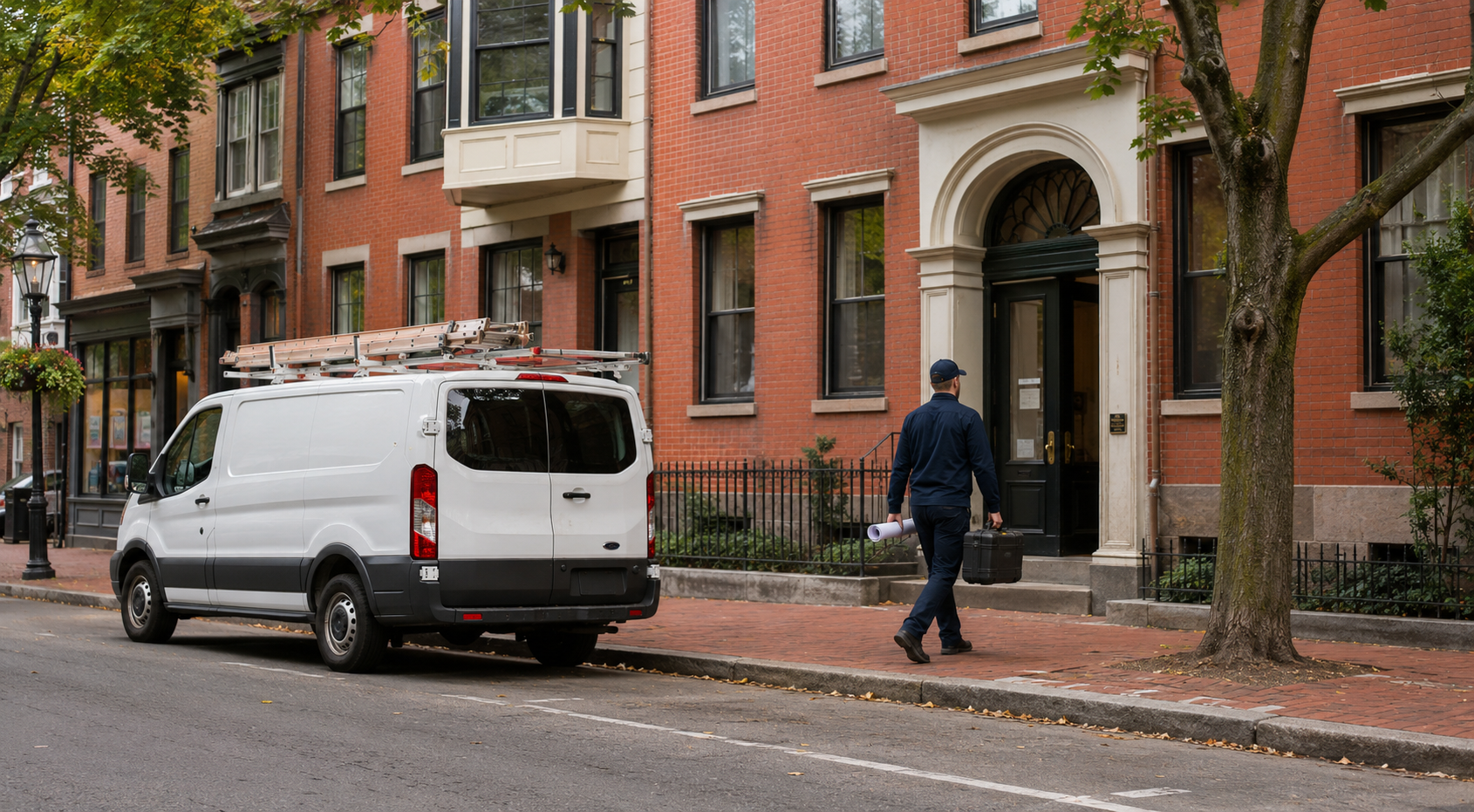
Four kinds of Salem building, four different fire alarm conversations
Salem packs an unusual range of occupancies into one small city — a regional hospital, a university, some of the country’s oldest museums and a dense mixed-use downtown. Each changes what the fire alarm system has to do.
Healthcare and medical offices
Salem Hospital, part of Mass General Brigham, is the North Shore’s largest healthcare provider and the city’s largest employer, with roughly 3,374 people on staff — and a ring of medical office buildings in its orbit. Healthcare occupancies carry the heaviest code load of anything we work on: the documentation — device inventories, test records, impairment procedures — matters as much as the hardware, because it is what every inspection and accreditation review asks for first.
Campus and institutional
Salem State University, founded in 1854, puts about 6,200 students in residence halls, labs, assembly spaces and offices on one campus. Institutional work is a scheduling problem as much as a technical one: systems, upgrades and acceptance testing get sequenced around the academic calendar, and every building answers to its own occupancy requirements.
Museums and cultural buildings
The Peabody Essex Museum, founded in 1799, is the oldest continuously operating museum in the country; the House of the Seven Gables and the Salem Maritime National Historic Site at Derby Wharf round out a cultural stock few cities can match. Here the system has to protect collections and historic fabric at the same time — detection chosen for early warning, and installation methods that leave the building the way we found it.
Downtown mixed-use and new construction
Along the Essex Street pedestrian mall, retail and restaurants run under apartments — one building, two occupancies, two schedules, one fire alarm system that has to annunciate clearly for both. And Salem is building: 1,347 housing units sit in the 2021–25 development pipeline, with The Exchange at 252 Bridge Street (115 units) expected to start construction in spring 2026. New construction is where the plan-review tiers above come into play from day one.
This page covers fire alarms. For access control, cameras and intrusion systems in the city — which run under a different set of Salem rules — see security systems in Salem.
Two things to plan around: October, and the waterfront
Neither shows up on a spec sheet, and both can move the cost or the schedule of a Salem fire alarm project.
Schedule downtown work outside October
October 2024 brought roughly 1.04 million visitors to Salem, with up to 80,000 people downtown on peak nights; Essex and Front Streets close to traffic from 9 a.m. to 10 p.m. on designated weekends, and parking enforcement is real — 1,666 resident-zone tickets and 237 tows that month. A contractor vehicle on a resident-permit street needs a $15-per-day city permit, and reserving a metered space runs $15 per space per day through the Parking Office (978-745-8120). The rules are reissued each year, so confirm the current notice — but the practical answer is simpler: we schedule downtown fire alarm work November through September.
Flood zones decide where the panel goes
Salem’s Flood Hazard Overlay covers the FEMA A, AE, AH, AO, A99, V and VE zones (current FIRM reference July 2025), and the C-ROD ordinance adopted in July 2024 requires building mechanicals in projected flood areas to sit above the projected 2070 flood level in new development and major renovations. A fire alarm panel and its communicator are exactly the kind of equipment that rule exists for. With offshore wind activity bringing new work to the harbor, we put waterfront panels and communicators above that line on the first drawing, not after a plan-review comment.
Winter and the communication path
In January 2026 a cold advisory took Salem to −5°F with wind chills near −25°F. On National Grid territory by the water, that is the argument for two design choices: a communicator that does not depend on premises broadband — cellular or AES radio — and low-temperature supervision points on any building that sits minimally heated, so a failing heating plant becomes a signal instead of a burst pipe.
Salem fire alarm questions we get
Does Salem still require a master box connection for commercial buildings?
No. The municipal master box network was decommissioned effective June 1, 2026. The city now accepts digital and cellular fire alarm communicators — AES radio, cellular and fire-rated IP — and there is no annual monitoring fee paid to the city. If a page you are reading describes a master box requirement or the $200 annual fee, it predates the change.
Our building still has its master box. What do we do with it?
The citywide circuit it reported over has been retired, so the box no longer reaches the fire department; buildings with private connections received direct notice from the city. The fix is a communicator changeover: a listed radio, cellular or fire-rated IP communicator takes over reporting, the alteration files under the city’s Fire Alarm System Shut Down Permit, the wiring gets a permit from the City Electrician, and the finished work is tested with Fire Prevention involved. It is a well-defined project — we monitor Salem systems reporting over these paths today.
Which permits does a commercial fire alarm project need in Salem?
Typically three threads: the fire side through the OpenGov portal (plan review for new construction, or the Fire Alarm System Shut Down Permit for changes to an existing system); an alarm wiring permit from the City Electrician at 44 Lafayette Street ($50 per unit plus $0.50 per device over 25); and, if the job alters a fire protection system or affects required egress, a building permit from Inspectional Services at 98 Washington Street. Inspections are scheduled by phone, not through the portal — a detail that catches out-of-town contractors regularly.
Our building is in a historic district. Can fire alarm equipment go on it at all?
Yes — the districts govern what shows, not whether the building can be protected. Equipment and wiring stay off the main façade and out of view from public ways; runs go through the basement or interior, and any unavoidable exterior run follows corners, eaves or foundation lines, painted to match. Visible exterior work needs a Certificate of Appropriateness from the Historical Commission (applications 16 days before a meeting); non-visible work needs a Certificate of Non-Applicability. Designed for from the start, it is a paperwork step, not an obstacle.
When should we schedule fire alarm work in downtown Salem?
Any month but October. In October 2024 the city saw roughly 1.04 million visitors, weekend street closures on Essex and Front, and heavy parking enforcement; contractor vehicle access downtown takes daily permits. The seasonal rules are reissued each year, so we confirm the current notice before committing dates — but for planned work, November through September is the honest answer.
Salem work runs out of Topsfield
Our Topsfield office at 375 Boston Street is the closest to Salem, with Wakefield behind it — and the technician assigned to your building may live closer than either.
Topsfield
(978) 887-8341375 Boston Street, Topsfield — covering the North Shore and Essex County, Salem included.
Address, hours and directions →All of our offices, with hours and directions, are on the office directory. Monitored alarm signals are handled around the clock, separately from office hours.
Planning fire alarm work in Salem?
Tell us the building and what is driving the project — a master box changeover, a plan-review deadline, a system that failed inspection, new construction. We’ll tell you which permits apply, what the city’s fee schedule says, and what the historic district or flood overlay means for the design — before you commit to anything.
Massachusetts Guides
- Best Home Security Companies in Massachusetts (2026)
- Massachusetts Service Areas
- North Shore Security Systems
- North Shore Commercial Fire Alarms
City Guides
- Amesbury: Security systems · Commercial fire alarms
- Andover: Security systems · Commercial fire alarms
- Beverly: Security systems · Commercial fire alarms
- Boxford: Security systems · Commercial fire alarms
- Danvers: Security systems · Commercial fire alarms
- Essex: Security systems · Commercial fire alarms
- Georgetown: Security systems · Commercial fire alarms
- Gloucester: Security systems · Commercial fire alarms
- Groveland: Security systems · Commercial fire alarms
- Hamilton: Security systems · Commercial fire alarms
- Haverhill: Security systems · Commercial fire alarms
- Ipswich: Security systems · Commercial fire alarms
- Lawrence: Security systems · Commercial fire alarms
- Lynn: Security systems · Commercial fire alarms
- Lynnfield: Security systems · Commercial fire alarms
- Manchester-by-the-Sea: Security systems · Commercial fire alarms
- Marblehead: Security systems · Commercial fire alarms
- Merrimac: Security systems · Commercial fire alarms
- Methuen: Security systems · Commercial fire alarms
- Middleton: Security systems · Commercial fire alarms
- Newbury: Security systems · Commercial fire alarms
- Newburyport: Security systems · Commercial fire alarms
- North Andover: Security systems · Commercial fire alarms
- Peabody: Security systems · Commercial fire alarms
- Rockport: Security systems · Commercial fire alarms
- Rowley: Security systems · Commercial fire alarms
- Salem: Security systems · Commercial fire alarms
- Saugus: Security systems · Commercial fire alarms
- Swampscott: Security systems · Commercial fire alarms
- Topsfield: Security systems · Commercial fire alarms
- Wakefield: Commercial fire alarms
