
Security systems in Salem, MA
Security in Salem takes more than choosing a panel and mounting a few devices. The system has to fit the way the property is used, stay manageable when October changes the staffing and the traffic, and account for local alarm rules or historic-district review before installation begins.
We design, install, monitor and service security systems for Salem businesses and homes — we already support customers here, dispatched from our Topsfield office. Whether you need a new intrusion alarm, better camera coverage, managed access control or a practical takeover of existing equipment, we start with the property and the people who will use the system every day.
Salem is part of our Massachusetts coverage — served by our North Shore team.
Salem’s false-alarm rules matter
A well-designed alarm should protect the property without creating avoidable dispatches. In Salem, that is also a matter of local compliance. Under Salem Code Chapter 32, Article III, an alarm user must give the police chief the names and phone numbers of at least two other people who can be reached at any hour, are authorized to respond, and can open the premises.
two each calendar year $25
After three separate false alarms, the police chief can require a written report within 15 days explaining what was done to find and eliminate the cause.
After five, the chief can order the alarm disconnected for at least six months — and failing to submit a satisfactory report or pay consecutive false-alarm charges can also lead to discontinuance under the ordinance.
That makes setup, training and maintenance part of the security plan, not an afterthought. We reduce preventable activations by matching sensors to the environment, setting sensible entry and exit delays, assigning individual user codes, testing communications and keeping the call list accurate. Just as important, we teach authorized users how to arm, disarm and cancel an alarm correctly. No alarm company can promise zero false alarms — but recurring activations should be investigated, never treated as normal.
Commercial security built around Salem operations
The right commercial security system begins with the risks, routines and decision-makers at the site. A downtown storefront does not operate like a medical office, museum, restaurant, warehouse or multifamily property — and two businesses in the same building may need different schedules, permissions and response instructions.
Intrusion detection
Door and window contacts, motion detection, glass-break sensors and other devices selected for the property. The goal is deliberate coverage: protect the likely entry paths and important interior areas without placing devices where normal activity, vibration, drafts or environmental conditions will cause trouble.
For a business with multiple managers or shifts, individual user credentials and opening and closing alerts give far more useful accountability than one shared code. The event history shows who armed or disarmed the system and when, and remote management makes approved schedule changes easy to handle.
Security cameras
Cameras should be planned around the questions you may need to answer later. Who entered? Was the delivery completed? What happened at the register, the service counter, the stockroom, the rear door? Can faces and activity still be seen after dark?
We evaluate camera position, field of view, lighting, image detail, retention needs and network capacity together — which avoids the common failure where a camera technically covers an area but can’t produce useful detail when an incident occurs. For properties that need a more active deterrent, video monitoring and virtual guard options can add analytics, live intervention or event-based review on top of a properly designed camera system.
Access control
Access control replaces unmanaged keys and shared door codes with credentials that can be assigned, scheduled and revoked. Give employees, vendors and managers only the access they need, keep an activity history, and remove a lost card or a departed employee without rekeying every affected door.
Door hardware, locking arrangements, accessibility and emergency egress all have to work together. On an older or historically significant entrance, the least disruptive answer may be preserving the existing door and hardware while controlling a different opening — we review those constraints before recommending equipment.
One system, clearer information
When intrusion, video and access control are designed together, one event carries much more context: an after-hours door opening can be tied to a specific credential, a nearby camera and the alarm status at that moment — and you can manage it all remotely without stitching together unrelated apps and incomplete event histories.
Integration still has to earn its keep. We recommend the features that improve response, oversight or day-to-day use — not complexity for its own sake.
A security plan that can flex in October
October changes Salem’s operating rhythm even when the building itself does not. Retailers, restaurants, attractions, event spaces and downtown offices run longer hours, temporary workers, different delivery windows and extra managers — and sidewalk activity after hours looks nothing like a normal week in February.
- Give seasonal employees individual credentials with automatic expiration dates instead of sharing one permanent code.
- Adjust approved arming schedules and opening and closing alerts for extended hours.
- Create limited credentials for cleaners, vendors and deliveries rather than handing out master keys.
- Review camera angles and analytics so ordinary pedestrian traffic doesn’t drown out the events that matter.
- Confirm the contact list and escalation order before the busiest weeks begin.
- Remove temporary users and restore normal schedules promptly when the season ends.
These are small operational choices, but they keep the system manageable when the property is busiest — and they stop convenience from turning into a long-term security gap.
Cameras and keypads in Salem’s local historic districts
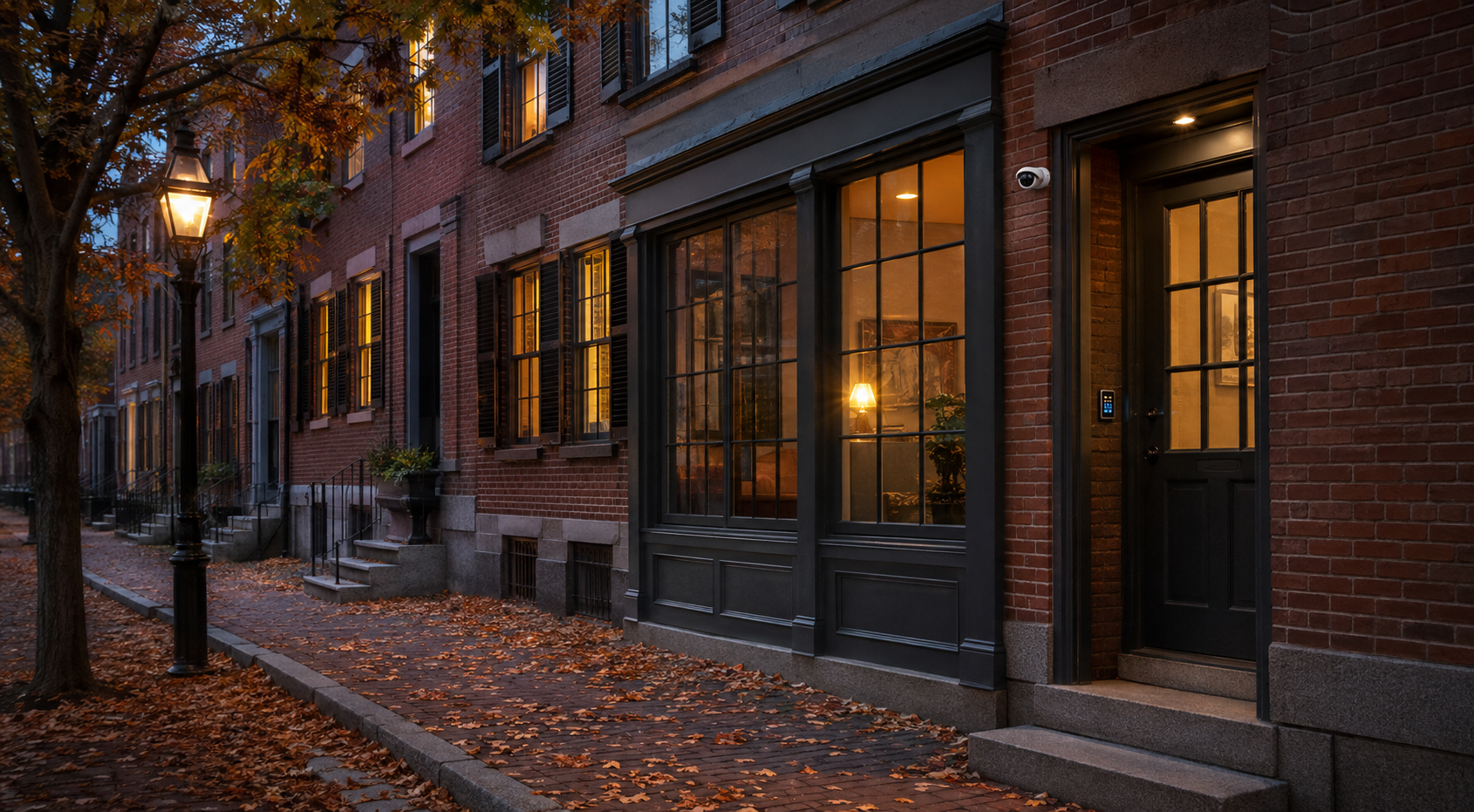
An older building is not automatically in a local historic district, but properties within the McIntire, Derby Street, Lafayette Street and Washington Square districts may need review for visible exterior work. The Salem Historical Commission reviews work in all four districts and publishes the current application process and design guidelines.
Those guidelines are unusually specific about security equipment. They generally favor cameras and similar devices at secondary entrances or façades, where visibility can be minimized. If a device must go on a primary or highly visible façade, it belongs in the most concealed practical location. Mounting should avoid historic material such as door trim and transom windows, use a minimally intrusive and reversible method, and coordinate device and conduit colors with the building wherever possible.
Access control deserves the same early look. Salem’s guidelines favor repairing and retaining historic door hardware and advise against replacing it with conspicuous contemporary digital locks, combination locks or keypads. That doesn’t mean a historic property can’t have modern security — it means equipment placement and door strategy get decided before holes are drilled or hardware is ordered.
We survey the proposed views, cable routes, mounting surfaces and controlled openings so you have a defined plan to present for any required review. Applications for Certificates of Appropriateness or Hardship are due 16 days before a Commission meeting, so approval timing belongs in the project schedule from the start.
Wired, wireless or hybrid?
Salem’s building stock makes one-size-fits-all answers especially unreliable. Thick masonry, plaster walls, metal lath, later additions and limited pathways affect both cable routing and wireless performance. A wireless device may preserve finishes in one room but struggle through several dense walls; a hardwired device may be rock-solid where a pathway already exists but needlessly disruptive where new cable would cross intact historic material.
Hardwired
Makes excellent use of existing cable and open pathways — especially during a renovation, when walls are already open.
Wireless
Reduces disturbance and speeds installation — once signal strength, battery access and device placement are verified at the actual locations.
Hybrid
Combines both: keep useful existing wiring, add wireless devices where running new cable is impractical.
We test likely device locations rather than assuming a wireless signal will be strong enough, and we inspect existing panels, sensors, keypads, communicators and wiring before recommending replacement. In many cases an alarm system takeover can retain compatible equipment and move monitoring or management to a system that is easier to support. Where equipment is obsolete, locked, damaged or incompatible, we explain what can stay and what should change.
Home security for Salem houses, condos and apartments
Home security systems should reflect the residence, not a standard equipment bundle. A single-family home with a basement entrance and a detached garage has different priorities than a condominium with one unit door, shared halls and association-controlled exterior space.
We design protection around accessible doors and windows, interior movement, cameras, video doorbells and compatible environmental sensors. Remote arming, user-specific codes and activity alerts earn their keep in households with children, caregivers, cleaners, dog walkers or short periods of authorized access.
For condominium owners and landlords, responsibility needs to be clear before installation. A resident may control devices inside the unit but need association, owner or property-manager approval for an exterior camera, common-area coverage, shared door hardware or cabling outside the unit. Camera views should stay on legitimate areas of concern and out of neighboring doors, windows and private spaces.
More than burglary alerts
A compatible security platform can also watch for conditions that threaten the property without an intruder anywhere in sight. Depending on the site, we may recommend sensors for:
- Water near basement mechanical equipment, laundry areas and other leak-prone spots.
- Low indoor temperature during cold weather.
- Loss of power or communication.
- Refrigeration and freezer temperature at businesses where stored product matters.
These alerts buy you the chance to investigate sooner — they don’t replace maintenance, proper insulation, plumbing protection or automatic shutoff equipment where those are needed. The useful question isn’t how many sensors can be added; it’s which conditions would justify an immediate call or notification.
Be deliberate about camera audio
Video capability does not automatically make audio recording appropriate. Massachusetts General Laws Chapter 272, Section 99 restricts the secret interception and recording of oral communications, so cameras, door stations and intercoms with microphones should never have audio recording enabled casually. Decide whether audio is genuinely necessary, establish an appropriate notice and consent policy, and get legal advice for the proposed use. We configure supported features according to your approved plan — we don’t provide legal advice.
24/7 monitoring with local service behind it
With professional alarm monitoring, signals from a compatible system are handled around the clock according to your account instructions and the applicable verification procedures. We monitor through Affiliated Monitoring, whose UL Listed, TMA Five Diamond monitoring centers run redundant operations. Depending on the equipment and the property, communication can use internet, cellular, landline or compatible private-mesh paths.
Monitoring and local service play different roles. The monitoring center handles incoming signals 24/7; our technicians install, maintain and repair the equipment producing those signals. Our North Shore office at 375 Boston Street in Topsfield serves Salem and the surrounding area, backed by field-based technicians and our broader Massachusetts team.
What to expect from a Salem security project
- Site survey. We walk the property, discuss risks and routines, inspect existing equipment, and test likely device and communication locations.
- System plan. We define coverage, user roles, monitoring, camera views, access levels, cable routes, and any historic-review or permit questions.
- Installation and programming. Devices are installed, labeled and programmed to the approved design, with attention to finishes and future service access.
- Training and handoff. Authorized users learn daily operation, alerts, credential management and false-alarm prevention. The contact and response list is confirmed before activation.
- Ongoing support. We coordinate monitoring, service the system, and help as staffing, occupancy or the property changes.
Security and commercial fire protection are separate scopes with different code and approval requirements. For fire alarm planning, see our page on commercial fire alarm systems in Salem.
Salem security questions we get
Do I need to register a security alarm in Salem?
Salem’s alarm ordinance requires every alarm user to give the police chief at least two additional day-or-night contacts who are authorized to respond and can open the premises, and it authorizes the chief to issue rules governing alarm systems. Municipal forms and filing procedures can change, so confirm the current process with the Salem Police Department — or ask us to confirm the steps during project planning. Alarm and low-voltage wiring permits are a separate question and may involve Salem’s City Electrician.
When does Salem charge for false alarms?
The ordinance assesses $25 for each false alarm above two in a calendar year, so the charge begins with the third. After three separate false alarms, the police chief can require a corrective report within 15 days; after five, the chief can order the alarm discontinued for at least six months. Confirm current requirements with the city before relying on them for a specific incident.
Can I install exterior cameras in a Salem historic district?
Usually — the first step is confirming whether the property sits inside one of Salem’s four local historic districts and whether the proposed work requires a certificate. The current guidelines favor less-visible locations, minimally intrusive and reversible mounting, protection of historic materials, and colors that blend with the building. Define the camera views and mounting details before applying, so the Commission can review a specific proposal.
Is wireless security reliable in an older Salem building?
It can be — but it should be tested at the actual device locations. Masonry, plaster, metal lath, floor level and distance from the panel all affect communication. A hybrid design is often the most practical answer: keep reliable existing wire, use wireless devices where cable would damage finishes, and add repeaters or communication paths only where testing shows they’re needed.
Can Cunningham take over my existing alarm system?
Often, yes. We start by checking the panel, sensors, keypads, wiring, communicator, programming access and monitoring compatibility. Usable equipment stays; obsolete, proprietary, damaged or unsupported components may need replacement. You get a clear recommendation after the system has actually been inspected.
Does Cunningham serve both Salem businesses and homes?
Yes. We design and service commercial and residential security systems in Salem — intrusion alarms, cameras, access control, compatible environmental sensors and 24/7 monitored accounts — with the design and equipment matched to the property rather than forcing a home and a business into the same package.
Can my Salem security cameras record audio?
The equipment may be technically capable of it, but Massachusetts law restricts secret interception and recording of oral communications. Don’t enable audio by default. Decide whether it’s necessary, get legal advice, and establish an appropriate notice and consent policy before using it.
Start with a Salem site assessment
Tell us what you need to protect, how the property is used, and what equipment is already in place. We’ll help you separate essential coverage from optional features, account for Salem-specific requirements, and build a system your staff or household can operate confidently.
Local requirements reviewed August 2026. Municipal procedures and regulations can change — confirm current requirements for your property and project before installation.
Massachusetts Guides
- Best Home Security Companies in Massachusetts (2026)
- Massachusetts Service Areas
- North Shore Security Systems
- North Shore Commercial Fire Alarms
City Guides
- Amesbury: Security systems · Commercial fire alarms
- Andover: Security systems · Commercial fire alarms
- Beverly: Security systems · Commercial fire alarms
- Boxford: Security systems · Commercial fire alarms
- Danvers: Security systems · Commercial fire alarms
- Essex: Security systems · Commercial fire alarms
- Georgetown: Security systems · Commercial fire alarms
- Gloucester: Security systems · Commercial fire alarms
- Groveland: Security systems · Commercial fire alarms
- Hamilton: Security systems · Commercial fire alarms
- Haverhill: Security systems · Commercial fire alarms
- Ipswich: Security systems · Commercial fire alarms
- Lawrence: Security systems · Commercial fire alarms
- Lynn: Security systems · Commercial fire alarms
- Lynnfield: Security systems · Commercial fire alarms
- Manchester-by-the-Sea: Security systems · Commercial fire alarms
- Marblehead: Security systems · Commercial fire alarms
- Merrimac: Security systems · Commercial fire alarms
- Methuen: Security systems · Commercial fire alarms
- Middleton: Security systems · Commercial fire alarms
- Newbury: Security systems · Commercial fire alarms
- Newburyport: Security systems · Commercial fire alarms
- North Andover: Security systems · Commercial fire alarms
- Peabody: Security systems · Commercial fire alarms
- Rockport: Security systems · Commercial fire alarms
- Rowley: Security systems · Commercial fire alarms
- Salem: Security systems · Commercial fire alarms
- Saugus: Security systems · Commercial fire alarms
- Swampscott: Security systems · Commercial fire alarms
- Topsfield: Security systems · Commercial fire alarms
- Wakefield: Commercial fire alarms
