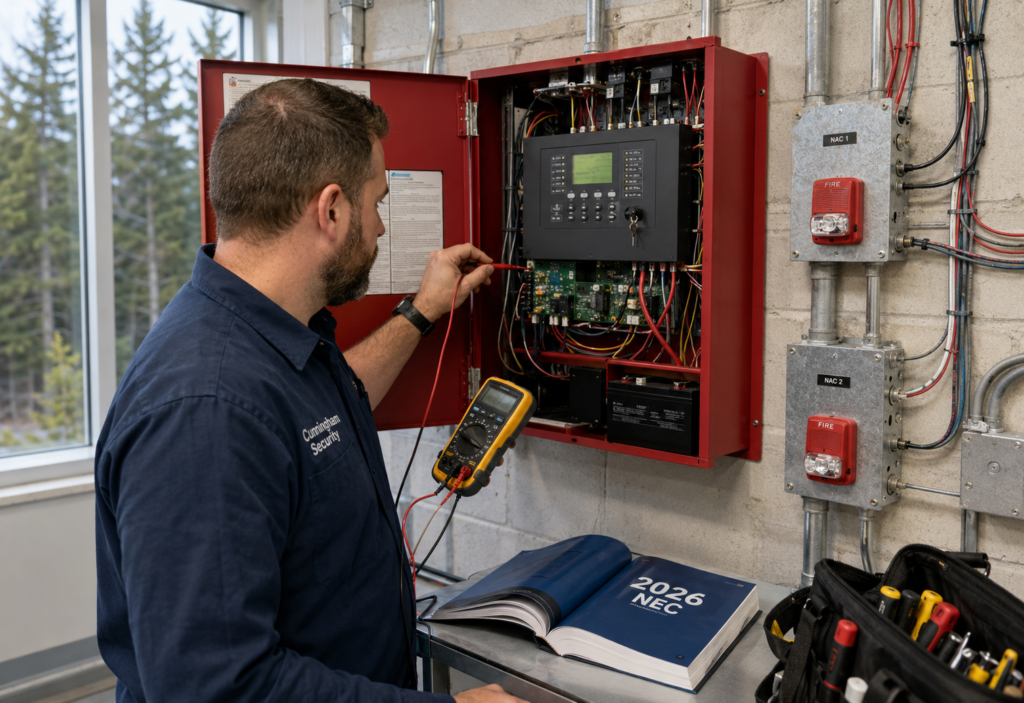
The 2026 NEC Is Now Live in Maine: What It Changes for Fire Alarm Projects
As of July 1, 2026, electrical installations commencing in Maine must comply with the 2026 National Electrical Code. The Electricians’ Examining Board adopted the new edition — with Maine amendments — through a repeal and replacement of its Chapter 120 installation standards, ending one of the shortest code runs in recent state history: the 2023 NEC governed Maine work for just two years.
For fire alarm projects, the practical news is reassuring: the 2026 edition reorganizes how the code is structured more than it rewrites what installers must do. Here is what changed, which edition governs your project, and what it means for the wiring behind your fire alarm system.
- EffectiveInstallations commencing on or after July 1, 2026
- Adopted byMaine Electricians’ Examining Board, Chapter 120
- Replaces2023 NEC (in force since July 1, 2024)
- UnchangedNFPA 72 (2019) remains Maine’s fire alarm standard
What changed on July 1, 2026
Maine adopts the National Electrical Code through the Electricians’ Examining Board, which repealed and replaced its Chapter 120, Electrical Installation Standards, to incorporate the 2026 NEC by reference — subject to the amendments and inclusions written into the Maine rule. The operative line is simple: all installations of electrical equipment commencing on or after July 1, 2026 must comply with the 2026 edition. The 2023 NEC, which had governed Maine installations since July 1, 2024, is retired for new work after only two years in force.
The changeover ripples through the trade in a way that benefits building owners: Maine requires licensed electricians to complete approved update training on the newly adopted code, so the crews wiring your building this year are being trained on the 2026 edition, not working from memory of an older book.
Which edition governs your project
The rule keys on when the installation commences, not when the system was designed or quoted. In practice that creates three situations. Work that began before July 1, 2026 continues under the 2023 edition it started under. Work commencing on or after July 1 falls under the 2026 edition, even if the drawings were produced earlier. And projects designed under the 2023 NEC but breaking ground now deserve a conversation with the electrical inspector before rough-in, so nobody discovers a discrepancy at inspection time.
Our practice: every Cunningham proposal names the code of record — the NEC edition, the adopted NFPA editions, and any Maine amendments in play — before design begins, and we document the commencement date so the governing edition is never a matter of memory. If your project straddles the changeover, we confirm the answer with the inspector in writing.
What the 2026 NEC changes for fire alarm work
Industry analysis of the 2026 edition points to reorganization more than reinvention where fire alarms are concerned:
- “Low voltage” is retired as a term. The 2026 NEC moves to “limited energy” language and restructures Chapter 7 around it, with general articles covering requirements, power sources, and cables that the fire alarm article now references.
- Article 760 survives intact. Fire alarm systems remain governed by their own article and are not reclassified as ordinary limited-energy circuits — the separation, identification, and survivability expectations that make fire alarm wiring different are preserved.
- Cable classes carry over. The familiar FPL, FPLR, and FPLP fire alarm cable ratings — and the substitution hierarchy between them — continue, with clarifications to the structure rather than new technical criteria.
- Inspections get a broader map. Electrical inspectors now verify fire alarm wiring against the general limited-energy articles plus Article 760, so submittals and field work should anticipate the multi-article framework.
Two things follow from that. First, a fire alarm designed and installed correctly under long-standing practice does not suddenly become wrong — the discipline is stable even though the code’s table of contents moved. Second, the details still matter at inspection: circuit identification, pathway protection, power supply and surge protection for the panel, and cable listing for the space it runs through are all still checked, now through the reorganized structure. This is also a good moment to remember that the fuel gas detector expansion took effect the same year — our summary of Maine’s 2026 fuel gas detector requirements covers that separate statute.
Two codes, one system
The NEC and NFPA 72 divide the work. The NEC — now the 2026 edition in Maine — governs the electrical side: the circuits, conductors, pathways, power supplies, and wiring methods behind the system. NFPA 72 governs the system itself: design, device placement, sequences, testing, and maintenance — and NFPA 72 explicitly requires that fire alarm wiring comply with the NEC’s fire alarm article, so the two standards are designed to interlock. Maine’s adopted fire alarm standard did not change with this adoption: the State Fire Marshal’s rules continue to incorporate NFPA 72, 2019 edition. The full picture of how Maine’s codes layer together — fire alarm, life safety, building, and electrical — is in the code stack section of our Maine fire alarm guide.
Licenses and permits didn’t move
The adoption changes the rulebook, not the process. Fire alarm wiring in Maine remains licensed electrical work, the electrical permit remains its own approval separate from fire plan review, and the inspection before wiring is concealed still happens — all as before. What changed is the edition those licenses, permits, and inspections enforce. Our fire alarm permits guide walks through the full permit picture for alarm projects.
What building owners should do
- Starting a project now? Confirm your contractor is designing to the 2026 NEC and Maine’s amendments, and that the proposal states the code of record in writing.
- Mid-project across the changeover? Ask which edition your electrical inspector is applying and get the answer documented before rough-in inspection.
- Existing system, no new work? A new code edition does not, by itself, obligate you to rewire a compliant existing installation — new editions govern new work. Changes typically enter your building when you renovate, expand, or replace equipment.
2026 NEC in Maine: FAQs
Does the 2026 NEC apply to my project that's already underway?
Maine’s rule applies the 2026 edition to installations commencing on or after July 1, 2026. Work that legitimately began before that date continues under the 2023 edition. If your project sits near the line — designed under the old edition, starting under the new one — confirm the governing edition with your electrical inspector before rough-in and get it in writing.
Do I have to upgrade my existing fire alarm wiring to the 2026 NEC?
Not because of the adoption alone. New code editions govern new installations; a compliant existing system is not retroactively obligated to meet the new edition simply because the calendar turned. The new requirements generally reach your building through new work — renovations, expansions, panel replacements — or through a specific directive from an authority. When we touch an existing system, we identify exactly which parts of the work the current edition governs.
Did Maine's fire alarm code change too?
No. The State Fire Marshal’s rules continue to incorporate NFPA 72 (2019 edition) as Maine’s fire alarm and signaling standard. The 2026 NEC adoption changes the electrical code that governs the wiring, circuits, and power behind the system — the fire alarm standard itself is a separate adoption on its own schedule.
Who inspects the electrical side of a fire alarm installation?
The electrical inspector for your jurisdiction, under the electrical permit — a separate approval from fire alarm plan review and the fire department’s acceptance test. Alarm wiring is inspected before it is concealed, against the NEC edition in force for the project. One project can therefore involve the fire reviewer, the local fire department, and the electrical inspector, each checking different things.
Planning Fire Alarm Work Under the New Code?
We design to the current editions Maine actually enforces — the 2026 NEC, Maine’s amendments, and NFPA 72 (2019) — and we put the code of record in writing on every proposal, so your project passes inspection without surprises.
Request a Quote Call (866) 551-6377