Maine Now Requires Fuel Gas Detectors in Businesses, Stores, and Assembly Buildings (2026)
As of January 1, 2026, Maine law requires a listed fuel gas detector in every room containing a propane, natural‑gas, or LP‑gas appliance in covered business, mercantile, and assembly occupancies — extending a requirement that has applied to apartment buildings, hotels, and other residential occupancies since 2022.
If you run a restaurant, a store, an office with a gas‑fired furnace room, a function hall, or a church in Maine, this law now reaches you. Here is what 25 M.R.S. §2469 requires, what it deliberately does not require, and how to get compliant without overbuying.
- EffectiveJanuary 1, 2026
- Newly coveredBusiness, mercantile & assembly occupancies
- RequirementA listed detector in every room with a gas appliance
- Statute25 M.R.S. §2469
What changed on January 1, 2026
Maine’s fuel gas detector statute arrived in two phases. Since January 1, 2022, it has required detectors in specified residential and lodging settings — buildings occupied by three or more families, dormitories and fraternity or sorority houses, children’s homes and group residences, hotels, motels, and inns, and certain mixed‑use residential buildings. The second phase was deferred four years to give commercial owners time: beginning January 1, 2026, the statute also applies to business occupancies (offices, professional services, and similar uses), mercantile occupancies (stores and retail), and assembly occupancies (restaurants, function halls, theaters, places of worship, and other gathering spaces).
The core requirement is the same in every covered building: at least one approved, listed fuel gas detector in each room containing an appliance fueled by propane, natural gas, or any liquefied petroleum gas. Owner‑occupied single‑family homes remain generally outside the statute except in connection with a sale or transfer.
The law Farmington built
This statute has a specific origin. On September 16, 2019, a propane explosion leveled the LEAP building in Farmington, killing Farmington Fire Rescue Captain Michael Bell and injuring six other firefighters and the building’s maintenance supervisor. A construction crew had unknowingly severed an underground propane line days earlier; hundreds of gallons of propane vaporized into the basement before anyone recognized the danger. The bill that became §2469 was introduced within weeks of the explosion and has been widely described as the first statewide fuel gas detector requirement in the country.
That history explains the law’s logic: smoke alarms and CO detectors were already common, but nothing in most buildings was listening for the gas itself. A fuel gas detector sounds an alarm when propane, natural gas, or LP gas reaches a preset concentration in the air — early warning for exactly the kind of accumulation that preceded Farmington.
What §2469 actually requires
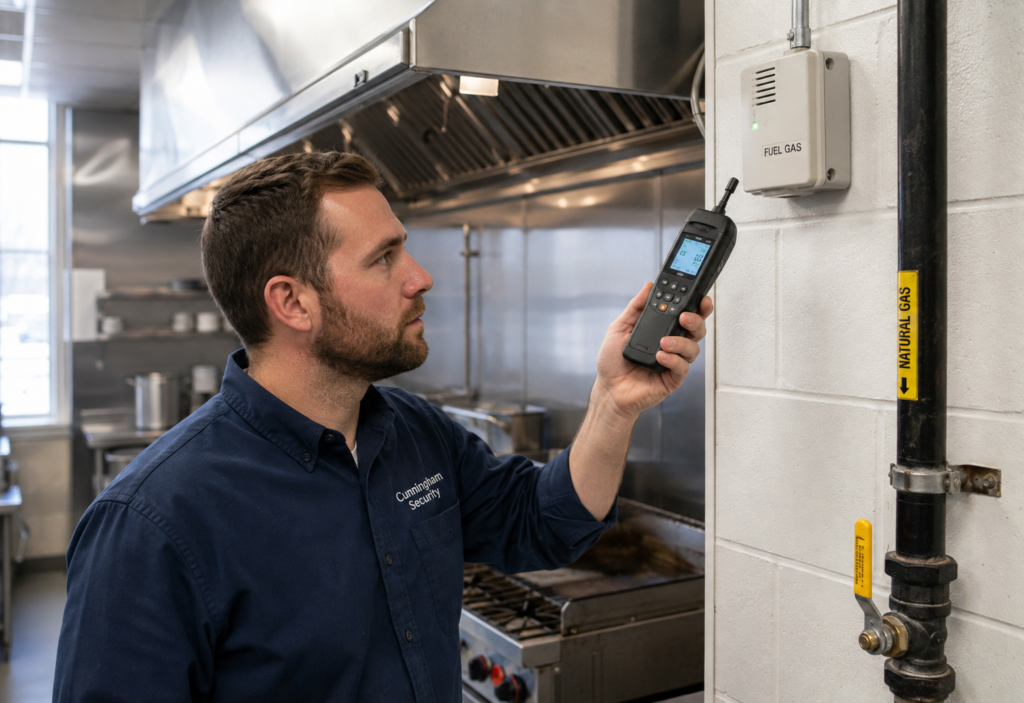
- Where: at least one approved fuel gas detector in every room containing an appliance fueled by propane, natural gas, or LP gas — think kitchens with gas ranges, mechanical and boiler rooms, laundry rooms with gas dryers, and spaces with gas unit heaters or fireplaces.
- What kind of device: a listed detector that senses the specific fuel gas present. The statute accepts battery‑powered units, plug‑in units with battery backup, and hardwired units with battery backup, provided they meet the listing and approval language.
- Whose job it is: the building owner is responsible for installation and maintenance — not the propane or gas supplier.
- The stakes: violations can draw a civil penalty of up to $500 under the statute — and, more to the point, an undetected leak can be catastrophic.
The State Fire Marshal publishes a plain‑language fuel gas detector guide that pairs well with the statute text. When in doubt about a specific room or appliance, the Office of the State Fire Marshal and your local fire department are the authorities to ask.
What the law does not require
§2469 is deliberately narrower than people assume. It does not universally require that detectors connect to your fire alarm panel, shut a gas valve, report to a central station, or dispatch the fire department. A standalone listed detector in each covered room can satisfy the statute. Requirements beyond that — monitored points, supervised circuits, valve interlocks — can arise from a product listing, another code, your approved design, or your AHJ, but they are not invented by this statute. Knowing that difference keeps you from being oversold.
Where this shows up in real Maine buildings
In practice, the 2026 expansion most often touches: restaurant and function‑hall kitchens with gas cooking equipment; retail and office buildings with gas‑fired furnaces, boilers, or rooftop‑adjacent mechanical rooms; churches and halls with gas heat or gas fireplaces; breweries and commercial kitchens with propane‑fired equipment; and shops or warehouses heated by gas unit heaters. Walk your building room by room: anywhere a gas appliance lives, the statute now expects a detector in that room.
Choosing and placing detectors correctly
Two details matter more than brand. First, the sensor must match the gas: propane and LP gas are heavier than air and pool low, while natural gas is lighter and rises — so the correct device and its mounting height depend on which fuel the appliance burns. Follow the detector’s listing and the manufacturer’s instructions for placement. Second, a fuel gas detector is its own device category: it is not a carbon monoxide detector and not a smoke alarm, and none of the three substitutes for another. Many Maine buildings need all three, each governed by its own statute — our Maine smoke & CO requirements cheat sheet covers the residential side.
Standalone or monitored? A design decision worth two minutes
For many small occupancies, listed standalone detectors are the right answer: compliant, effective, inexpensive. But if your building already has a commercial fire alarm or staff are not always present, there is a strong case for gas detection as monitored points — a leak signal at 2 a.m. in an empty function hall accomplishes nothing unless someone hears it. As part of our environmental detection services, we evaluate whether standalone devices satisfy your obligation or whether supervised, centrally monitored detection makes sense for the building — and we design it as part of the system covered in our Maine fire alarm guide so signals are classified and handled correctly.
A simple compliance path
- Inventory: walk the building and list every room containing a propane, natural‑gas, or LP‑gas appliance.
- Match: select listed detectors rated for the specific gas in each room, in a power configuration the statute accepts.
- Place: mount per the listing and manufacturer instructions — low for propane and LP gas, high for natural gas.
- Decide: standalone, or tied into your fire alarm as monitored points — get a professional opinion if the building is unstaffed at times.
- Document and maintain: keep the purchase and placement record, test on the manufacturer’s schedule, and replace units at end of listed life.
Fuel gas detector FAQs
Does my Maine restaurant need fuel gas detectors now?
If it has propane or natural‑gas cooking or heating equipment, yes — assembly occupancies came under 25 M.R.S. §2469 on January 1, 2026, and the statute requires a listed detector in every room containing a gas appliance. That typically means the kitchen and any mechanical or boiler room, at minimum.
I already have CO detectors. Is that enough?
No. A carbon monoxide detector senses a combustion byproduct; a fuel gas detector senses the fuel itself — propane, natural gas, or LP gas — before ignition. They are separate devices under separate Maine statutes, and one does not satisfy the other’s requirement.
Are battery-powered detectors acceptable?
Yes. The statute accepts battery‑powered detectors, plug‑in detectors with battery backup, and hardwired detectors with battery backup, provided the device is listed and approved for the gas involved. Which configuration is smartest depends on the room, the appliance, and whether the detector will be monitored.
Do the detectors have to be connected to my fire alarm or a central station?
The statute itself does not require it — standalone listed detectors can comply. But monitoring is often worth it in buildings that sit empty overnight, and a product listing, another code, your approved design, or your AHJ can call for system connection in specific cases. We evaluate that question building by building.
Not Sure What Your Building Needs?
We will walk the building with you, identify every covered room, and tell you honestly whether standalone detectors satisfy the statute or monitored gas detection makes sense — then handle the installation either way.
Request a Quote Call (866) 551-6377