
Maine Fire Marshal Plan Review Fees Changed in July 2026: What Project Budgets Should Expect
For applications submitted to the Maine State Fire Marshal on or after July 29, 2026, construction plan review is billed at 0.20% of the reviewable project cost, plus a surcharge of six cents per occupied square foot — up from the prior 0.15% and four cents.
Two 2026 session laws made the change, and the Fire Marshal’s application packets were updated on July 27, 2026 to match. If your fire alarm project is part of covered construction, this line item just moved — and a surprising amount of outdated fee information is still circulating online. Here is the current picture.
- Applies toSFM applications on or after July 29, 2026
- Plan review0.20% of reviewable project cost
- Surcharge6¢ per occupied square foot
- Enacted byPL 2025, ch. 658 & ch. 650
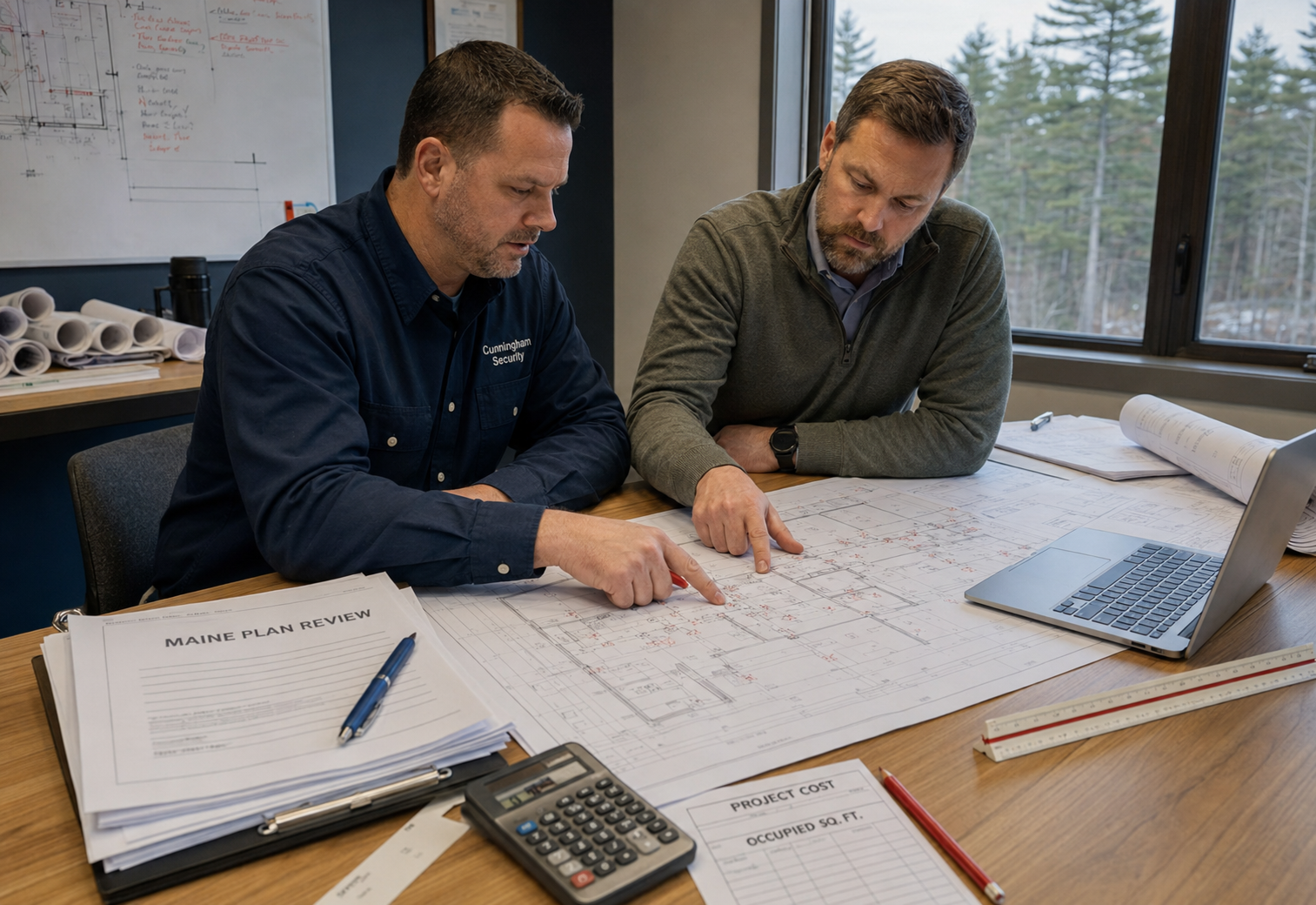
What changed, and when
Maine’s state construction review runs through the Office of the State Fire Marshal under 25 M.R.S. §2448, and the review carries two charges: a plan-review fee and a building-code surcharge. Both moved this year. Public Law 2025, chapter 658 (LD 2223) set the plan-review fee at 0.20% of the cost of the reviewable project, replacing the prior 0.15%. Public Law 2025, chapter 650 (LD 2212), approved April 10, 2026, raised the occupied-space surcharge from four cents to six cents per occupied square foot — the surcharge that funds Maine’s building-code program. The Fire Marshal’s office applies the new amounts to applications submitted on or after July 29, 2026, and issued updated application packets dated July 27, 2026 reflecting them.
Does your project pay this fee at all?
Only projects that go through state construction review do. The §2448 permit covers construction and changes of use in covered public buildings — and a new fire alarm system can be part of what triggers that review. Some building types, such as standalone storage or industrial buildings, one- and two-family homes, and privately owned apartment buildings, can fall outside the state construction-permit category, though that is not an exemption from fire codes, detector statutes, the electrical permit, or municipal permits. Two cities are a special case: Portland and Waterville conduct specified reviews locally under delegation, using the delegated-community application process and their own municipal fee schedules — Portland’s permit portal, for example, notes a new Fire Prevention Cost Recovery Fee effective July 1, 2026. The full map of who reviews what is in the permits section of our Maine fire alarm guide.
What the new math looks like
An illustrative example
Take a renovation with a reviewable project cost of $250,000 and 8,000 occupied square feet. Under the new schedule, plan review is 0.20% × $250,000 = $500, and the surcharge is 6¢ × 8,000 = $480 — roughly $980 in state review charges. The same project under the prior amounts would have run about $695. The figures here are illustrative only: “reviewable project cost” and “occupied square feet” are determined through the application itself, so always calculate from the current packet when filing.
Watch out for stale fee information
As of this writing, older fee tables are still easy to find: superseded application packets, statute pages that have not yet caught up with the 2026 session laws, and agency pages referencing fee changes from years past. If a form or website shows 0.15%, four cents, or an old dollar-tier table, it predates the change. Work from the packets dated July 27, 2026 — the state construction packet or the delegated-community packet where applicable — and confirm amounts with the Fire Marshal’s office at filing.
What this change does not touch
The plan-review fee is one line in a project budget, not the whole permitting picture. The electrical permit for alarm wiring remains its own approval with its own fee — the currently posted state schedule lists $75 for an electrical alarm system, and municipal-permit jurisdictions use their own schedules. Local fire and building permit fees, acceptance-test charges, monitoring service, and recurring inspection costs are all separate and unaffected by the state change. It has also been a busy year for Maine project requirements generally — the 2026 NEC took effect July 1 for new installations — so a proposal written in 2025 may deserve a fresh look on several fronts.
Our practice: every Cunningham proposal itemizes the approvals a project needs and who obtains each one, so review fees show up as named line items instead of surprises. For the bigger budgeting picture, see what affects fire alarm cost in Maine and our fire alarm permits guide.
Plan review fee FAQs
My application went in before July 29, 2026. Which fees apply?
The new amounts apply to applications submitted to the State Fire Marshal on or after July 29, 2026. Earlier filings were assessed under the schedule in effect when they were submitted. If your project was quoted before the change but has not been filed yet, budget for the new amounts.
Does this fee apply to my Portland project?
It depends on the review path. Portland conducts specified reviews locally under state delegation, using the delegated-community application process and the city’s own fee schedules — including a Fire Prevention Cost Recovery Fee the city’s portal lists as effective July 1, 2026. Projects reviewed directly by the State Fire Marshal pay the state amounts. We confirm which door a given project goes through, and what it costs, before we price the work.
Is this the same as the electrical permit fee for alarm wiring?
No. Plan review is charged by the State Fire Marshal for construction review of covered projects. The electrical permit for alarm wiring is a separate approval under Maine’s electrical laws with its own fee — currently listed at $75 for an electrical alarm system on the posted state schedule, with municipal jurisdictions setting their own. One fire alarm project can involve both, plus local permits.
Budgeting a Maine Fire Alarm Project?
We map every required approval — state, municipal, and electrical — name the fees, and put the whole path in the proposal, so your budget reflects what filing actually costs in 2026.
Request a Quote Call (866) 551-6377