
Ring Alarm vs. a Professionally Installed Security System: An Honest Comparison
DIY security vs. a custom alarm system
Ring or a local professional? The honest answer depends on the property.
Ring delivers affordable DIY security and direct app control. A professionally installed system costs more, but adds property-specific design, verified testing, local support and more communication choices.
Information and advertised pricing reviewed July 26, 2026.
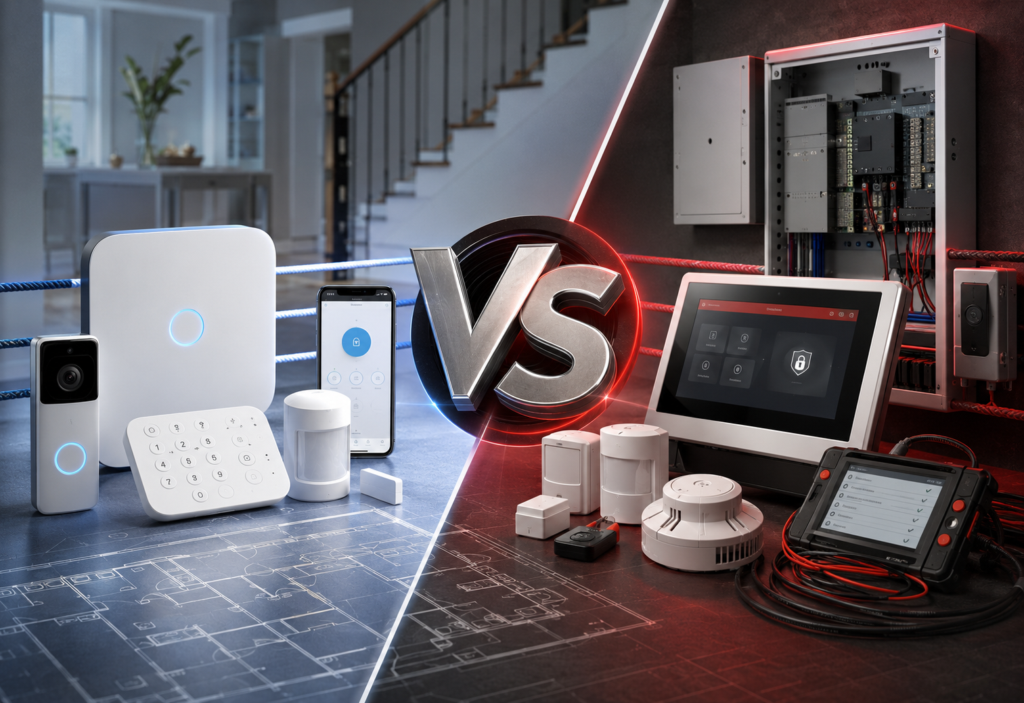
A transparent starting point: Cunningham Security designs, installs and services professional alarm systems, so we have an obvious point of view. Ring is also a legitimate choice—not a product we need to dismiss. This comparison uses Ring's own current product information and identifies places where either option can be the better value.
The short answer: Choose Ring when low initial cost, fast DIY setup and direct app control matter most—and the property is straightforward enough for you to design and test the system confidently. Choose a local professional when you want someone accountable for coverage, sensor placement, programming, signal verification, service and future changes. Larger, historic, coastal, seasonal, multi-building and heavily customized properties tend to benefit most from professional design.
Ring vs. a professionally installed security system at a glance
| Category | Ring DIY system | Cunningham custom system |
|---|---|---|
| Initial cost | Usually lower. Ring's five-piece Alarm kit was listed at $199.99 before promotions. | Usually higher because equipment, design, installation, programming and testing are included in the project. |
| Monitoring | Self-monitoring is available; Ring's Pro plan was listed at $19.99/month with 24/7 professional monitoring. | 24/7 professional monitoring through Affiliated Monitoring. Residential service starts at $30/month for landline and $40/month for cellular; other configurations are quoted. |
| Design | You select device types, quantities and locations from Ring's ecosystem. | A professional evaluates the building, risks, routines, pets, communications and expansion plans before specifying equipment. |
| Installation | Designed for DIY setup. Optional third-party professional installation is available. | Installed, programmed, documented and commissioned by a security technician. |
| Testing | Ring provides device testing and Practice Mode; the owner is responsible for completing and maintaining the test process. | A technician can put the account on test, activate devices and verify the correct signals and zone descriptions arrive at the monitoring center. |
| App & automation | Strong Ring app, especially for customers already using Ring cameras or doorbells. | Alarm.com can integrate security, video, locks, thermostats, lights, access and environmental protection on compatible systems. |
| Communication | Internet connectivity plus cellular alarm backup with an eligible plan and compatible equipment. | Cellular, IP, landline and—in supported areas and applications—AES private mesh radio or an engineered redundant design. |
| Support model | National phone/chat support and owner-led administration. | Ongoing local relationship with people who know the system, property, monitoring account and regional requirements. |
| Best fit | Apartments, rentals, smaller homes, simple layouts and confident do-it-yourself owners. | Complex homes, businesses, seasonal properties, existing wired systems and customers who want one accountable service company. |
Prices are advertised prices checked on July 26, 2026, before taxes, permits, equipment additions or promotions. Features, prices and eligibility can change. See the linked provider pages before purchasing.
Price: Ring has the lower entry point, but compare complete systems
Ring's price advantage is real. As of our review, the five-piece Ring Alarm kit was listed at $199.99 and included a base station, keypad, one contact sensor, one motion detector and a range extender. Ring's Pro subscription, which includes 24/7 professional alarm monitoring, was listed at $19.99 per month or $199.99 per year. Ring frequently offers promotions, so the price on a given day may be lower.
A custom alarm system cannot be priced responsibly without knowing the number of openings, floors, outbuildings and special hazards; whether usable wiring already exists; and which communications and smart features are needed. Cunningham's published residential monitoring starts at $30 per month for compatible landline systems and $40 per month for cellular service. IP, AES, dual-path and specialized configurations require a quote. The initial agreement is 12 months and then continues month-to-month.
What may increase a Ring total
- Enough contacts for every door or window you intend to protect
- Additional motion, glass-break, smoke/CO, water or freeze devices
- Cameras, doorbells, locks and ongoing video storage
- Range extenders or a larger kit for a spread-out building
- Optional professional installation, advertised as starting around $129 per device
What the professional project price buys
- A site survey and equipment plan based on actual risks and construction
- Installation, clean device placement, programming and user training
- Monitoring-account setup with useful zones and response instructions
- End-to-end signal testing and documentation
- A local company responsible for service after installation
The fairest comparison is not a starter kit versus a complete custom system. Build two lists that protect the same openings and hazards, include the monitoring and video features you expect, and compare the three- to five-year cost. For a small home, Ring may still win decisively. As the device count and complexity grow, the gap often narrows.
Customization: Ring is modular; a professional system is property-specific
Ring is more flexible than some people assume. Its ecosystem includes entry contacts, motion and glass-break detection, keypads, panic features, cameras, locks, water/freeze devices and smoke/CO options. Ring also sells a Retrofit Alarm Kit that can connect up to eight existing hardwired contact zones. Ring states that the retrofit module does not reuse old wired keypads or wired smoke/CO devices.
The difference is not that Ring has no choices. It is who is responsible for making the choices. In a DIY installation, you decide what to protect, how many devices are needed, where they should go and whether wireless range, pets, temperature, humidity or building materials will affect them.
A local installer can specify wired, wireless or hybrid equipment around the property. That matters in older New England homes with thick plaster or masonry; seasonal and coastal properties exposed to cold, moisture and long vacant periods; finished homes where existing wiring should be preserved; buildings with detached garages or barns; and businesses that need partitions, many users or opening-and-closing reports.
Professional customization can also extend beyond intrusion. A compatible Alarm.com system may combine app control, cameras, locks, thermostats, lighting, smoke/CO, low-temperature and water protection. The exact features depend on the panel, equipment and service package, but the system can be designed to expand without starting over.
This article focuses on the complete alarm system. If cameras and live video intervention are the main concern, see the separate Ring Virtual Security Guard vs. Alarm.com video monitoring comparison.
Professional installation is really about responsibility—and verified testing
Ring was designed to be installed by the customer, and many people complete the setup successfully. Ring provides device health information, test tools and a Practice Mode for monitored accounts. Optional third-party installation is also available. For someone comfortable following instructions and maintaining the system, DIY can be a sensible way to save money.
A Cunningham installation shifts responsibility to a trained technician. The technician is not simply attaching sensors. The work can include checking wireless performance, choosing detector locations, preserving usable wiring, labeling zones, configuring users, setting call lists and special instructions, testing backup power and confirming the communication path.
What “send test signals” should mean
That distinction matters. A sensor can beep locally while a programming, account or communications issue prevents the right signal from reaching the right place. Supported systems can also send recurring test or supervision signals to help expose a communications problem before an emergency. Cunningham's monitoring service uses Affiliated Monitoring, while Cunningham remains responsible for design, programming, testing, service and account coordination.
Monitoring and communication paths: app convenience is not the whole design
Ring can be self-monitored. The alarm can sound and notify the owner, but the owner must evaluate the event and call for help. Ring's eligible paid plan adds 24/7 professional monitoring and cellular alarm backup through a third-party carrier. That is a meaningful upgrade over an internet-only notification system.
A professional installer can evaluate cellular coverage, customer internet, available wiring, backup power, the building's risk and local network availability before selecting a path. Cunningham can work with cellular, IP, traditional landline and AES private mesh radio. There is no single best path for every property.
What AES adds: AES describes its IntelliNet technology as a private, purpose-built, self-healing mesh network for alarm communications. It does not rely on a public cellular carrier. Where Cunningham's AES network, compatible equipment and the application support it, AES can be an important alarm-reporting option—especially when cellular coverage is weak or the owner wants a path independent of carrier technology changes.
Can a system keep Alarm.com benefits and also use AES?
Potentially, but this must be engineered for the exact panel and monitoring configuration. Many Alarm.com systems use cellular and broadband together for Alarm.com's app, alerts, automation and video features. On certain compatible systems, Cunningham may be able to design separate Alarm.com and AES communication functions so the customer retains Alarm.com's interactive benefits while AES carries an additional alarm-reporting role.
This is not a universal plug-in combination, and “dual-path” in Alarm.com documentation ordinarily means cellular plus broadband—not automatically AES. Alarm.com also cautions that unsupported third-party communicators used with its modules may behave unexpectedly. Cunningham should approve the panel, modules, reporting roles and monitoring setup before promising this architecture.
For customers who do not need AES, Alarm.com cellular/IP communication may already provide the right balance. For customers who do, the value of a custom installer is the ability to evaluate and document the complete path rather than assume every property should use the same radio.
Privacy and data protection: the honest comparison is nuanced
It would be inaccurate to say Ring does not protect customer data. Ring says cloud video is encrypted in transit and at rest, requires two-step verification and offers optional end-to-end video encryption on eligible devices. End-to-end encryption can disable certain sharing, search, preview, detection and monitoring features, so customers should understand the tradeoff. Ring explains these controls on its privacy and security page.
Alarm.com publishes a different and meaningful commitment: it pledges not to sell activity data from customers' homes or businesses. Its U.S. privacy policy describes security controls informed by NIST and Center for Internet Security standards. Alarm.com still collects information needed to operate its services and may share it with the authorized dealer, monitoring station, service providers or when legally required.
No connected platform can honestly promise absolute security. Both Ring and Alarm.com publish substantive safeguards. Alarm.com's advantages in a Cunningham installation are its explicit activity-data pledge, professional system programming and a local company that can help administer the account—not a claim that every other platform is unsafe.
Whichever system you choose, use a unique password, protect the associated email account, enable multi-factor authentication, remove former users promptly and keep phones, apps and network equipment updated.
Local support: self-service control versus a continuing relationship
Ring provides national phone and chat support, extensive documentation and direct owner control. That model is efficient for customers who like troubleshooting, installing new devices and managing their own account. Ring owners can create and change access codes in the app and schedule guest access on supported setups.
A local installer adds a different kind of value: people nearby who know local properties and the history of the particular system. With Cunningham's regional offices and service teams, a customer can call about a recurring false alarm, a failing sensor, an employee or tenant who needs a code, a property addition, an internet or cellular change, or a confusing monitoring-center interaction. On compatible Alarm.com systems, customers may still manage codes and users in the app; local support is there when they do not want to handle everything themselves.
Regional familiarity also helps with issues that a national product wizard cannot fully anticipate:
- Local alarm-registration and false-alarm rules that vary by municipality
- Historic construction, dense masonry, seasonal cottages and coastal exposure
- Long winter vacancies, low-temperature risks and second-home access
- Property-manager, cleaner, contractor and employee code turnover
- Site-specific police, fire, keyholder and monitoring instructions
- On-site troubleshooting when remote steps do not solve the problem
The central station still handles signals around the clock. Cunningham partners with Affiliated Monitoring for that role and has an elevated route for account coordination and escalations. The benefit is national-scale monitoring infrastructure with a local company that stays accountable for the system.
Insurance, water leaks and “flood coverage”: important distinctions
Can either system qualify for an insurance discount?
Yes—potentially. Ring customers with eligible professional monitoring can obtain a Ring monitoring certificate. A Cunningham customer can also request proof of monitored protection. Insurers such as State Farm and Travelers describe possible protective-device discounts, but requirements and savings vary by carrier, policy and state.
A professionally installed system does not automatically produce a bigger discount. Its practical advantage is documentation and the ability to design monitored smoke, CO, low-temperature, water or automatic-shutoff protection when the insurer recognizes those measures. Ask the insurer what it requires before choosing equipment, and do not let an estimated discount replace a complete cost comparison.
Ring has water and freeze detection, too
Ring offers flood/freeze sensors that can detect water or low temperature and provide alerts; eligible monitoring can add automated contact notifications. For a small property, a few well-placed Ring sensors may be all the customer needs.
A professionally designed system can go further where appropriate: multiple leak sensors at water heaters, laundry equipment, mechanical rooms and sump areas; monitored water-leak and low-temperature protection; water-flow monitoring; and compatible automatic shutoff valves. Alarm.com's Water Dragon, for example, is designed to watch water flow and pipe temperature and can alert users to unusual use and freeze risk.
Detection is not insurance coverage. A sensor or shutoff valve may prevent or reduce water damage, but it does not change the policy. Rising-water flooding is commonly excluded from standard homeowners insurance and generally requires separate flood insurance. Review the National Flood Insurance Program information and speak with a licensed insurance professional about the property.
What Ring is genuinely good at
Ring's biggest strengths are not just price. It has a polished consumer experience and makes basic security approachable. Ring is often a strong choice when:
- The home, apartment or rental has a simple layout and a modest number of openings
- The owner wants to install immediately without scheduling a site visit
- The household already uses Ring doorbells or cameras and wants one familiar app
- The customer values flexible self-monitoring or low-cost professional monitoring
- The owner is comfortable choosing locations, testing devices and maintaining the system
- Moving the equipment later is an important consideration
Someone who buys an appropriately sized Ring system, installs it carefully, enables professional monitoring when desired, tests it and keeps account information current may be better protected than someone who owns an elaborate system but never uses or maintains it.
When a professionally installed system earns the additional cost
A custom system becomes more compelling when the risk of missing something is greater than the savings from doing it yourself. Consider professionally designed home security when:
- The property is large, historic, coastal, seasonal, multi-story or spread across several buildings
- There is existing hardwired equipment worth evaluating or reusing
- Smoke, CO, low temperature, water, panic or business-operation signals need a coordinated design
- The customer wants multiple communication choices, including AES where supported
- Many family members, tenants, contractors or employees require managed codes and schedules
- The system needs cameras, locks, thermostats, access control or automation to work together
- The owner wants a technician to verify every critical signal with the monitoring center
- Local on-site service and one accountable company matter after installation
If an existing alarm already has useful equipment, a complete replacement may not be necessary. Cunningham can inspect many older systems, determine what can remain and quote an alarm monitoring takeover or selective upgrade.
Our bottom line: Ring wins the simplicity-and-price contest for many straightforward homes. A Cunningham system wins when the customer is purchasing expertise and accountability, not merely more sensors. The right decision comes from comparing equivalent coverage, realistic long-term cost and who will be responsible when the system needs to change or prove that it works.
Frequently asked questions
Is Ring cheaper than a professionally installed security system?
Usually, especially at the start. Ring sells low-cost starter kits and its advertised professional-monitoring price is below Cunningham's current starting monitoring rates. The fairest comparison includes enough sensors for the same coverage, any cameras and video storage, optional installation, environmental devices and several years of service.
Is Ring professionally monitored?
It can be. Ring supports self-monitoring and offers 24/7 professional monitoring with an eligible paid plan. Self-monitored customers are responsible for reviewing alerts and contacting emergency services themselves.
Can Ring qualify for a homeowners insurance discount?
Possibly. Eligible professionally monitored Ring customers can obtain a monitoring certificate, and professionally monitored dealer systems can also provide documentation. The insurer decides whether either system qualifies and how much, if anything, the policyholder saves.
Can Alarm.com and AES be used on the same security project?
On certain engineered systems, separate Alarm.com and AES functions may be possible, but it is not a universal or plug-and-play combination. Compatibility depends on the panel, communicators, reporting configuration, monitoring setup and local AES coverage. Cunningham should approve the exact architecture before it is specified.
Does a local installer manage alarm codes for the customer?
Cunningham can help add, remove or troubleshoot users and codes on supported systems, while many Alarm.com customers can also manage them directly in the app. Ring likewise provides owner-managed codes. The difference is the option to call local people who already know the system when changes are confusing or urgent.
How does a professional installer know the alarm is communicating?
A technician can place the monitoring account on test, activate selected devices and verify that the monitoring center receives the expected signal types and correct zone descriptions. Supported systems can also send recurring test or supervision signals.
Do Ring or Alarm.com water sensors provide flood insurance?
No. They can alert occupants and, with compatible professional designs, may trigger automatic water shutoff. They do not create or modify insurance coverage. External flooding commonly requires a separate flood policy.
Is Alarm.com more secure than Ring?
Both publish meaningful security controls, and no connected platform is risk-free. Ring describes encryption, mandatory two-step verification and optional end-to-end video encryption. Alarm.com pledges not to sell home or business activity data and describes a security program informed by recognized standards. A professional Alarm.com installation also adds local account and system stewardship.
Primary sources and further reading
- Ring Alarm kit pricing, contents and specifications
- Ring subscription and professional monitoring plans
- Ring professional monitoring and self-monitoring
- Ring privacy and security controls
- Alarm.com privacy pledge and U.S. privacy policy
- How Alarm.com professional installation works
- AES private mesh technology benefits
- Affiliated Monitoring real-time test-signal verification
- National Flood Insurance Program eligibility and coverage information
Want a real comparison for your property?
Tell Cunningham what you would protect with Ring and which features matter to you. We can price an equivalent professionally installed system, explain what existing equipment can be reused and show where professional design adds value—or tell you honestly when a simple system may be enough.
Request a security system quote